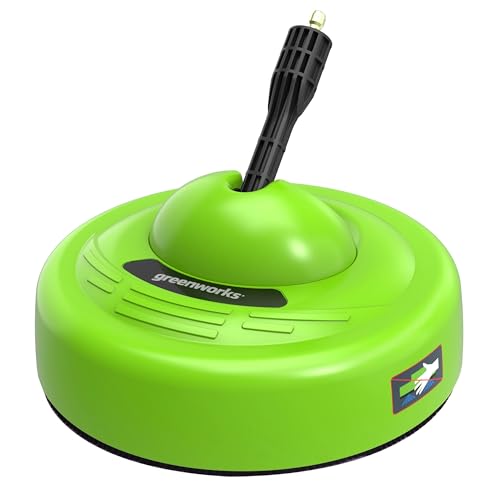
These are the two accessories people buy to speed up concrete, they are sold side by side, and they do genuinely different jobs. The deciding factor is not preference — it is your machine’s flow rate, which rules one of them out entirely on a lot of machines.
Side by side
| | Turbo nozzle | Surface cleaner |
|---|
| Minimum flow to work | Any machine, with a matched orifice | 1.2 GPM for 11in, 1.6 for 14in, 2.1 for 15in |
| Coverage per pass | A few inches | 11 to 15 inches |
| Evenness | Even only if you hold a constant distance | Even by design - the housing sets the height |
| Edges, corners, steps | Yes - this is its best use | No. It cannot reach the last inch |
| Overspray | Everywhere, including on you | Contained by the skirt |
| Damage risk | High. Pausing etches concrete, and it ruins wood | Low. Force is split and never stationary |
| Noise and fatigue | Loud, and it vibrates your wrist | You push it. Far easier over an hour |
The flow rate question decides it first
A surface cleaner is spun by water volume through angled nozzles. At 1.2 GPM you are limited to an 11-inch head, and much below that nothing will spin usefully at all.
A turbo nozzle has no such constraint — it works on any machine as long as the orifice size matches your flow. Which means on a low-flow electric the turbo nozzle is not the compromise option, it is the correct one. Check your own numbers against the sizing guide.
If your machine can drive a head, the head wins on open concrete
It is three to five times faster across a driveway, the finish is even without any technique, the spray stays contained instead of soaking the garage door and your legs, and you push it rather than sweeping a wand at arm’s length for two hours.
It is also far less likely to damage anything: the force is split between nozzles on a fast-spinning bar at a fixed height, so no point gets more than a fraction of a second of exposure and you physically cannot hold it still. Picks: surface cleaners.
The turbo nozzle wins everywhere the head cannot go
Every surface cleaner leaves an uncleaned strip against walls, curbs and garage thresholds, and it cannot do corners, aprons or steps. That perimeter work is exactly what a turbo nozzle is for, and it is the reason to own one even if you have a head.
It also handles the odd stubborn patch — a tar mark, a spot of set-in film — faster than any fan tip. Picks: turbo nozzles.
What neither of them does
Remove an oil stain. Oil is soaked into the slab rather than sitting on it, and that is a chemical job at any pressure.
Kill algae. Both remove the visible layer and leave the organism, which is why a cleaned driveway often looks green again by midsummer. A cleaner with real biocidal action, left to dwell, is what makes the result last.
And neither belongs on wood, siding, sand-jointed pavers or anything painted — the turbo nozzle emphatically so. The never-pressure-wash list applies.
What I would buy
Under 1.6 GPM: the turbo nozzle, plus an 11-inch head only if your driveway is large enough to justify the extra passes.
1.6 GPM and up: the correctly sized surface cleaner first, then a turbo nozzle for the edges. Together they are under a hundred dollars and they turn the worst job a house has into a morning. The full sequence is in how to pressure wash a driveway.