“My driveway is dirty” covers three unrelated problems, and buying the wrong product for yours is why people conclude concrete cleaners do not work.
Identify which problem you have
General grime — an overall gray dulling, worse near the road. Comes off with a surface cleaner and water, and comes off faster and more evenly with a cleaner.
Biological growth — green film, black patches, or slippery areas in shade and under trees. This is the one that returns, and it is why a freshly cleaned driveway often looks bad again by midsummer. Needs a cleaner that kills it.
Oil and grease — dark patches where a car parks. Soaked into the slab rather than sitting on it. No amount of pressure will lift it. Needs a product designed to draw it out, left to work, sometimes overnight.
A driveway often has all three, in which case treat the oil first, then the growth, then clean the whole slab.
What to buy for each
Grime and light growth: an oxygenated concrete cleaner. The Oxy Solve Concrete and Driveway formulation is kinder to the planting at the edges and covers a large driveway per bottle at its stated dilution.
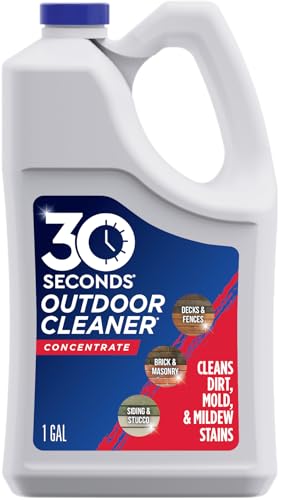
Heavy growth and dull gray concrete: something stronger. The Zep concrete concentrate visibly brightens a dull slab, and 30 Seconds acts on green growth within minutes rather than weeks. Both need more care around plants and metal, and both must be rinsed thoroughly.
Motor oil: a dedicated pull-out stain remover. It is slow — apply, leave, sometimes overnight — and it is the only category of product that addresses the actual mechanism. Results on very old deep stains are partial rather than perfect, and anyone promising otherwise is overselling.
Why your driveway went green again
Because the last clean was mechanical. A surface cleaner removes the visible layer of algae beautifully and leaves the spores in the concrete pores. Within weeks, given shade and moisture, it is back.
A cleaner with real biocidal action, left to dwell, buys you a season or more. That is genuinely the difference between cleaning the driveway once and cleaning it twice a year.
Technique for concrete specifically
Pre-wet the slab. Dry concrete absorbs cleaner unevenly and leaves tide marks.
Work in sections small enough that it will not dry. On a hot day that may be surprisingly small; a dried cleaner has stopped working.
Do the edges first. A surface cleaner cannot reach them, and doing them last flushes dirt back across clean slab.
Rinse in one direction. Push the dirty water off the slab rather than fanning it around, and let it dry evenly.
Full sequence in how to pressure wash a driveway.
A note on acid cleaners
Muriatic and other acid cleaners are sold for concrete and they will etch the surface, which permanently changes its appearance and makes it absorb dirt faster afterwards. They have a place in preparing bare concrete for a coating, and almost none in cleaning a driveway you want to look good. Avoid them for this job.
Dilution and coverage arithmetic is in house wash mix ratios, and the application mechanism in how soap injectors work.