The best pressure washer for concrete is the Greenworks Pro 2300: a certified 2,300 PSI at 2.3 GPM, which is the flow figure that actually finishes a slab, without an engine to maintain. If the concrete is a long driveway or a large yard and you want it done in a morning, the gas Westinghouse WPX3400 moves 2.6 GPM and finishes faster than anything electric here.
Concrete is the surface people buy the most pressure for and the surface where pressure helps least. The grime sits in an open, porous, mineral surface that takes almost anything you point at it — so the limiting factor is never how hard you hit it, it is how much water you can move across it per minute. Everything below is ranked on that.
This page is about concrete as a material: garage floors, basement floors, patio slabs, paths, steps, block walls and pads. If the specific job is a driveway, with its slope, its oil drips and its car traffic, the method is on how to pressure wash a driveway and the driveway-shaped shortlist is on best pressure washers for driveways.
What concrete actually needs
Flow first: 2.0 GPM and up. Cleaning units — pressure multiplied by flow — track real cleaning speed far better than pressure alone. A 2,000 PSI machine at 2.3 GPM does more work per minute than a 3,000 PSI machine at 1.2, and it is far less likely to leave stripes. The arithmetic is in PSI vs GPM explained.
A surface cleaner, not a wand. This is the single biggest difference between a three-hour slab and a thirty-minute one, and it is also what stops the striping that a hand-held wand leaves on open concrete. It needs flow to spin: around 1.6 GPM for a 14-inch head and 2.1 GPM for a 15-inch. Check yours against the surface cleaner fit guide before buying a head.
Chemistry for anything organic or oily. Green and black film is biological and a cleaner left to dwell removes it far faster than pressure does. Motor oil is not a pressure problem at all — it has soaked into the pores, and only a degreaser lifts it. More PSI on an oil stain just polishes the concrete around it.
Enough pressure, which is less than you think. Around 2,000 to 3,000 PSI covers every homeowner concrete job. Above that you are into etching risk on softer, newer or decorative concrete, and the extra buys you nothing on speed that flow would not have bought you more cheaply.
The six, as the listings state them
| | Power | PSI | GPM | Biggest head it will drive |
|---|
| Greenworks Pro 2300 | Electric | 2,300 certified | 2.3 | 15-inch |
| Westinghouse WPX3400 | Gas | 3,400 | 2.6 | 15-inch, at full speed |
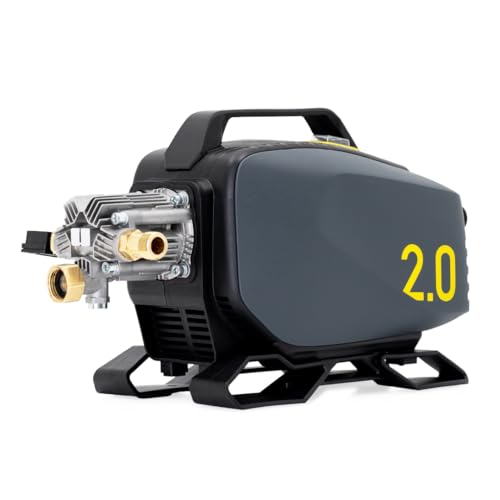
| Active 2.0 GPM | Electric | 1,800 | 2.0 | 14-inch |
| Westinghouse ePX3500 | Electric | 2,500 max | 1.76 max | 14-inch |
| Sun Joe SPX3000 | Electric | 2,500 max | Not published | 11-inch |
| Simple Green Oxy Solve Concrete | Cleaner | — | — | — |
The head column is the practical consequence of the flow column, and it is the number worth shopping on. A machine that cannot spin the attachment that does the work is the wrong machine for concrete regardless of its headline pressure.
Greenworks Pro 2300 — the one to buy
A certified 2,300 PSI at 2.3 GPM is the best combination on this page for someone who does not want an engine. The certification matters here more than usual: it is an independently measured working figure rather than a ceiling recorded at the instant the trigger closes, so what you read is close to what you feel at the nozzle. At 2.3 GPM it will drive a 15-inch surface cleaner, which puts it in the same practical class as a gas machine on flat concrete.
It wants a 15-amp circuit to itself, and it costs two to three times what the entry Greenworks machines cost. If the concrete in question is one small patio, that is more machine than the job needs.
Westinghouse WPX3400 — the fastest answer
2.6 GPM is the most water on this page and 3,400 PSI is more than concrete ever needs, which together mean a 15-inch head running at full speed and a long drive finished in a morning. The onboard soap tank is unusual at this price and genuinely useful, because concrete work is mostly chemistry plus flow.
It is a gas machine with everything that implies: oil changes, fuel stabilizer, winterizing, noise and a weight that makes it a two-person lift. And 3,400 PSI near decorative or newer concrete needs a wide tip and real distance, or you will leave a mark you cannot take back.
Active 2.0 GPM — the flow-per-dollar pick
2.0 GPM at a modest 1,800 PSI is close to the ideal trade for concrete: plenty of water, not enough pressure to etch anything. On the numbers it is the most sensible electric here.
The listing is clear that it is sold tool only, so the hose, the gun and the tips are separate purchases and the real delivered cost is higher than the headline. It is an excellent second machine for someone who already owns the accessories and a poor first one.
Westinghouse ePX3500 — the value pick
1.76 max GPM is nearly fifty percent more water than the 1.2 GPM that most electrics at this price publish, and that is the entire reason it is here. It will drive a 14-inch surface cleaner properly, which is enough for a patio, a path, steps and a single-car garage floor.
It is a max rating rather than a certified one, so treat the numbers as a ceiling, and a 14-inch head on a large driveway means more passes than a 15-inch would. Full write-up in the Westinghouse ePX3500 review.
Sun Joe SPX3000 — the budget pick
The cheapest machine here that will still make a visible difference to a slab, with two detergent tanks so the concrete cleaner can live in one and house wash in the other. For a small patio, a path or a set of steps it is enough.
The listing does not publish a flow figure, and on a machine at this price the honest expectation is that an 11-inch surface cleaner is the ceiling. A large driveway with it is an afternoon rather than an hour. The detail is in the Sun Joe SPX3000 review.
Simple Green Oxy Solve Concrete — the part that is not the machine
An oxygenated concentrate made for concrete and driveways, and the reason it is on a machine page is that half the stains people blame on an underpowered pressure washer are chemistry problems. Green film, black spotting and general gray weathering come off far faster with a cleaner left to dwell than with another 500 PSI.
It is not a degreaser and will not touch motor oil — that needs a dedicated product and patience, covered in best concrete cleaners. It also needs a surface cleaner or a methodical wand pass to work evenly; splashed on unevenly it leaves tide marks.
What pressure will never fix
Motor oil that has soaked in. It is below the surface. A degreaser, dwell time and sometimes two applications; pressure alone polishes the surrounding concrete and makes the stain look worse by contrast.
Rust from rebar or furniture feet. A chemical stain needing an oxalic-acid product, not force.
Spalling and pitting. Freeze-thaw damage to the concrete itself. Washing it reveals it; nothing in this category repairs it, and high pressure accelerates it.
Efflorescence, permanently. The white bloom is salt migrating out of the slab. It washes off and it comes back until the moisture path is dealt with.
How long a slab actually takes
The honest planning figures, and the reason flow is the specification that matters. A single-car garage floor is roughly 200 square feet; a typical two-car driveway is 600 and up. With a 15-inch surface cleaner behind 2.3 GPM or better, 600 square feet is a morning including the pre-soak and the rinse. With a wand and no surface cleaner, the same area is most of a day and it will stripe.
With a 1.2 GPM machine - which is what most electrics under $200 publish - an 11-inch head is the ceiling and the same driveway becomes a two-session job. That is not a defect in the machine; it is what buying on PSI instead of GPM costs you, measured in afternoons.
The order that makes the difference
Sweep first, and move everything. Loose grit under a spinning surface cleaner scratches the concrete and wrecks the skirt. Anything you leave on the slab gets cleaned around, and the outline shows afterwards.
Pre-wet, then apply the cleaner to a wet surface. A concentrate hitting dry concrete soaks in unevenly and leaves tide marks that are harder to remove than the original staining.
Let it dwell, and never let it dry. Five to ten minutes is where the work happens. On a hot day keep misting it. This single step does more than any upgrade from 2,000 to 3,000 PSI.
Work in overlapping passes with the head flat. Overlap by about a third. Tipping a surface cleaner onto one wheel is what causes the arc marks people blame on the machine.
Rinse the whole area in one direction. Dirty water drying on cleaned concrete is the most common reason a slab looks patchy after a good wash. The full step-by-step for a sloped drive is on how to pressure wash a driveway.
What I would buy
A patio, a path, a garage floor, no engine: Greenworks Pro 2300.
A long driveway, finished in one morning: Westinghouse WPX3400.
Least money, small areas: Sun Joe SPX3000, with the Oxy Solve concentrate.
Whichever you pick, buy the surface cleaner at the same time. On concrete it changes the result more than any upgrade to the machine itself.