
Best surface cleaner
Best pressure washer surface cleaners
Ranked with fit first: the right size for your machine beats the biggest head.
Top pick: Sun Joe SPX-SC14 14-Inch
The attachment that turns a three-hour driveway into a thirty-minute one.
It is a round housing with two or three nozzles mounted on a spinning bar underneath, and a skirt that keeps the spray contained. You push it across concrete like a floor polisher. Instead of a single jet that cleans a two-inch stripe, you get a 14 or 15-inch disc of even coverage. The time saving on a driveway is not marginal. The far bigger benefit is that it cleans evenly: no zebra stripes, no overlap marks, no sections you have to go back over because the light changed and you can suddenly see where you were.
This is the one thing to get right, and the reason most surface cleaner disappointment happens. A surface cleaner is driven by water flow, not pressure. The spray bar spins because water is being pushed through angled nozzles. If your machine does not move enough water per minute, the bar turns slowly or not at all, and you get a tool that cleans worse than the wand you already had.
Roughly: a 1.2 GPM electric machine wants an 11-inch head. A 1.6 to 2.0 GPM machine is happy with 14 inches. A 2.5 GPM gas machine can drive 15 inches or more at full speed. Buying a 15-inch head because it was only a few dollars more, and bolting it to a 1.2 GPM unit, is the most common mistake in this category. Will a surface cleaner work on my pressure washer walks through how to check your own numbers, and PSI vs GPM explains why flow is the deciding figure here when pressure is the deciding figure almost everywhere else.
Three things. Housing material — heavy-duty plastic is light and cheap and cracks if you drop it on concrete; stainless steel survives abuse and costs more. Wheels — a head with four wheels stays level, and level is what produces an even clean; three wheels tip over an expansion joint; no wheels means you are holding it flat by feel, which is tiring and inconsistent. The swivel — the rotating seal at the top is the part that eventually weeps, and the cheapest heads use the cheapest swivels. A plastic versus stainless comparison goes through whether the upgrade is worth it for your usage.
A surface cleaner cleans the middle of a flat area. It cannot reach the last inch against a wall, it cannot do edges or corners, and it cannot climb steps. You will still need a wand, and probably a turbo nozzle, for the perimeter. It also will not remove an oil stain: that is a chemical problem, not a mechanical one, and it needs the right cleaner.
And it is not only for concrete. On a composite or hardwood deck a surface cleaner at modest pressure is far safer than a wand, because the pressure is spread across a wide disc and you physically cannot hold it in one place. That is covered in the patio and deck picks.
If you already own a machine, check its GPM first, then go to the main picks. If you are still choosing a machine, buy one with the flow to drive a surface cleaner — that guidance lives in the pressure washers hub. And whatever head you buy, the results will be better with a cleaner on the concrete first, which is the soaps and detergents hub.
Best surface cleaner
Ranked with fit first: the right size for your machine beats the biggest head.
Top pick: Sun Joe SPX-SC14 14-Inch
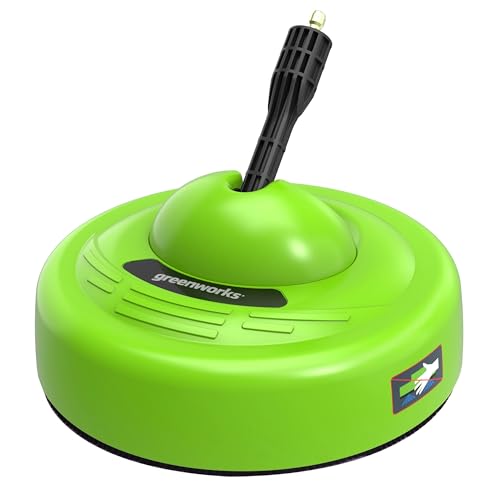
Best for electric machines
The 11 and 14-inch heads that spin properly on a low-flow electric machine.
Top pick: Greenworks 11-Inch Surface Cleaner
#ad Price as of October 5, 2026.How this is funded

Best for driveways
The bigger heads, for the one job where width genuinely pays.
Top pick: Simpson 15-Inch Steel Surface Cleaner
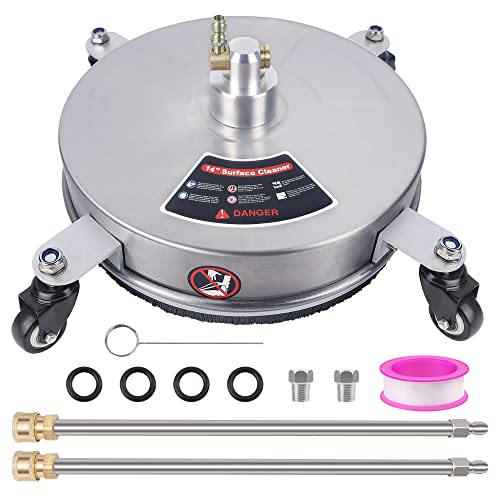
Best for patios and decks
Smaller, four-wheeled heads for pavers, timber and composite - and why they are safer than a wand.
Top pick: Biswing 14-Inch Surface Cleaner
#ad Price as of October 5, 2026.How this is funded
COMPARE
Each size, the flow it needs, and why 20 inches is a commercial-only answer.
Read it →
COMPARE
What the stainless premium buys, and the component that decides longevity on both.
Read it →
GUIDE
The four things a surface cleaner fixes, and the cases where you genuinely do not need one.
Read it →
GUIDE
The flow, size and fitting checks that stop you buying a head that will not spin.
Read it →
HOWTO
The sequence that produces an even clean, and why most striping is technique.
Read it →

FIX
A checklist in likelihood order - the first cause accounts for most cases.
Read it →