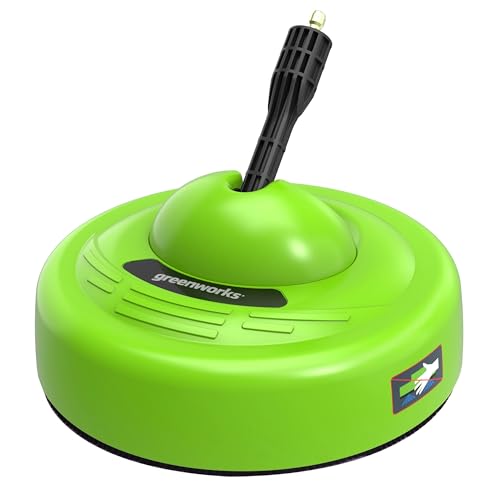
Work down this list in order. The first item accounts for more cases than everything below it combined, and most of the rest are fixed in ten minutes with no parts.
1. The head is too big for your machine’s flow
By far the most common cause, and the one that is not a fault. A surface cleaner is spun by water volume through angled nozzles. If your machine does 1.2 GPM and the head wants 2.1, it will crawl.
Check your machine’s GPM on its label against the sizing table in will a surface cleaner work on my pressure washer. If this is your problem, the fix is a smaller head — nothing else will help, and no amount of pressure substitutes for flow (why).
2. A blocked nozzle
There are only two or three nozzles under there and one partial blockage kills the spin. Grit from the supply, hard-water scale or dried detergent will do it.
Unscrew or pull the nozzles, hold them up to the light, and clear them with the thin wire that came with your machine or a paperclip — from the back, never by forcing anything into the orifice from the front. Then fit an inlet water filter so it does not happen again.
A related symptom: it spins but leaves a regular repeating pattern. That is one nozzle doing less work than the others.
3. Your water supply cannot keep up
A machine can only deliver its rated flow if the tap feeds it. Time a 5-gallon bucket from your outside tap: under 60 seconds is fine. Much slower and your effective flow is below the machine’s rating, which can push a borderline head into stalling.
Also check: the garden hose is not kinked, the inlet filter is not clogged, and you are not running an unnecessarily long or narrow supply hose.
4. The nozzles are the wrong orifice size
If you have replaced the nozzles, or the head shipped with a set intended for a bigger machine, oversized orifices bleed pressure without converting it into spin. Nozzle size must match the head’s intended flow, not just thread into it. Replacement sets state a GPM rating — use it.
5. Something is physically fouling the bar
Grit, a leaf stem, or a pebble wedged between the bar and the housing. Turn the head over and spin the bar by hand: it should move freely with slight resistance. If it drags, clean the inside of the housing out.
6. The swivel is failing
The rotating seal at the top is the one genuine wear part. When it goes you lose pressure internally, so the nozzles get less water and the bar slows — usually with a visible drip or weep from the top of the head while running.
Some heads sell a rebuild kit; many do not, and replacement is the practical answer. To delay it on the next one: run clean water through for thirty seconds after every use, especially after chemical work. More on which heads hold up in plastic vs stainless.
If it spins but cleans badly
That is usually technique or chemistry rather than the head: walking too fast for the spin speed, no cleaner applied, or no dwell time. Work through how to use a surface cleaner.
And if the machine itself is weak — everything is slow, not just the head — start at won’t build pressure instead.