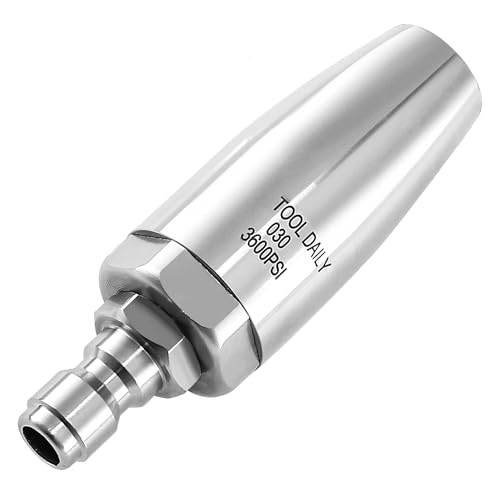
A turbo nozzle, sometimes sold as a rotary or dirt-blaster nozzle, fires a zero-degree jet in a fast cone. You get the cutting intensity of the red tip spread across roughly the area of a green one. On stained concrete it is dramatically faster than any fan tip, and on the wrong surface it is the most destructive thing you can fit.
What it is genuinely good at
Set-in concrete grime and algae — two or three times faster than a 25-degree tip, with a visible clean line behind it.
Edges and corners a surface cleaner cannot reach. This is the best reason to own one even if you have a surface cleaner: the perimeter strip, the curb line, the garage threshold and steps.
Low-flow machines on concrete. If your machine cannot drive a surface cleaner, a turbo nozzle is the correct accessory for hard surfaces. See do I need a surface cleaner.
What it will destroy
Wood, in a single pass — it carves grooves and raises the grain permanently. Vinyl siding. Painted anything. Soft or old concrete, which it etches into visible swirls if you pause. Pavers, whose jointing sand it removes completely. Car paint, obviously.
Two habits make it safe: keep it moving at all times, and keep it the same distance off the surface for the whole pass. The marks people complain about are almost always a moment of hesitation. The never-pressure-wash list applies doubly here.
Match the orifice size, or lose your pressure
Turbo nozzles are sold by orifice number — 3.0, 3.5, 4.0 and so on — and the number corresponds to a flow range. Too large for your machine and water passes through without building pressure, so the nozzle feels weak. Too small and you load the pump.
Roughly: a 1.2 to 2.0 GPM electric wants around 3.0; a 2.5 GPM gas machine wants around 4.0. If a listing does not state the orifice, treat that as a reason to buy a different one. The underlying logic is in PSI vs GPM.
Where the money goes
Bearings. The ceramic or steel bearing that lets the jet spin is the wear part, it is usually not serviceable, and it is why a turbo nozzle has a finite life. A budget one gives a season or two of occasional use; a better one lasts longer. Neither is repairable, so buying cheap is a defensible strategy.
Housing material. Stainless over plastic where the gap is small, mostly so dropping it on the driveway is not fatal.
Living with one
It is loud, it vibrates your wrist, and over a long session that is genuinely tiring — another reason a surface cleaner is the better tool for a big flat area and the turbo nozzle is for the edges.
Flush it with clean water after use, especially after chemical work, since grit and residue in the bearing is what ends it. And always test an inconspicuous patch of whatever you are about to clean. For whether a plain tip would do instead, read turbo nozzle vs regular nozzle.