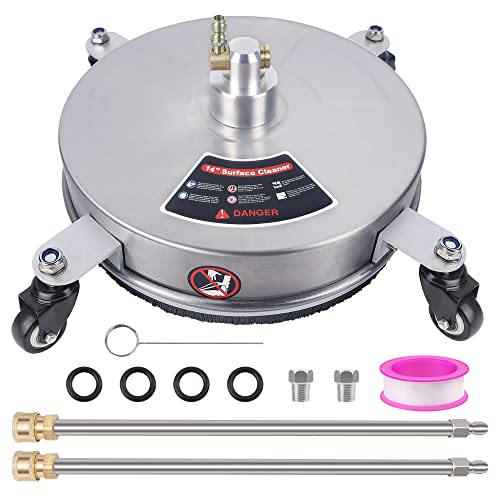
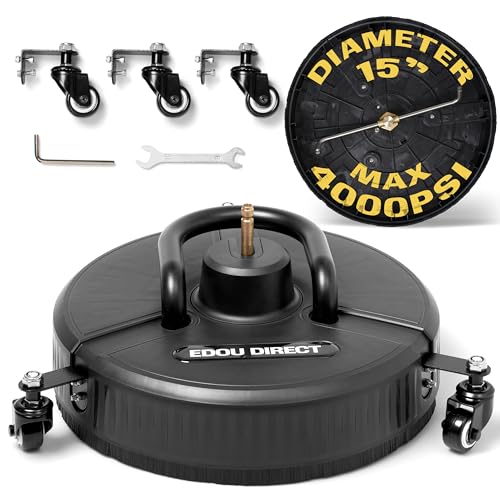
Surface cleaners come in two broad builds: a heavy-duty plastic housing, or stainless steel. The stainless ones cost more and the listings imply that settles it. The real picture is more interesting, because the housing material is not what usually kills one.
What each build is actually like
| | Heavy-duty plastic | Stainless steel |
|---|
| Weight | Lighter - noticeably less tiring over a long driveway | Heavier, which also helps it sit flat |
| Dropped on concrete | Can crack, especially cold | Scuffs and carries on |
| Scuff marks on pale paving | Possible from a hard skirt edge | Possible, same risk |
| Rust | None | None on the housing; fasteners vary |
| Price | Lowest in the category | Typically a modest premium, not a doubling |
The part that actually fails: the swivel
At the top of every surface cleaner is a rotating seal that lets the deck spin while the inlet stays still. That seal is under pressure, full of water, and moving. It is the component that weeps, and when it weeps you lose pressure to the nozzles and the head slows down.
A swivel is almost never mentioned in a listing, and it is not made of the housing material. Which means a stainless head with a cheap swivel will fail before a plastic head with a good one. When you read owner reports on these, the drip-by-month-three complaints cut across both builds — which tells you the housing is not the variable.
So when is stainless worth it?
Yes, if the gap is small. Where stainless costs ten or fifteen dollars more than plastic at the same size and wheel count — as it often does — take it. It is a free durability upgrade and the extra weight helps the deck sit level.
Yes, if you have rough broom-finish concrete or you will be moving the head in and out of a truck. Abrasion and impact are where plastic gives up.
No, if it means dropping to three wheels or a smaller-than-ideal size. Four wheels and correct sizing both affect your results on every single pass. Housing material affects what happens when you drop it. Buy the specification that works first.
No, if you are cleaning one patio a year. A plastic head will see out a decade of that, and the weight saving is real.
The buying order
- Correct size for your flow — non-negotiable. See the sizing table.
- Four wheels — this is what stops striping.
- Stainless, if it is still affordable after the first two.
- A handle, if the area is large.
Picks against that order are in the main roundup. And whatever you buy, the thing that will extend its life most is rinsing clean water through it after any chemical work, which is what preserves that swivel seal.