Skip to content
Pressurewasher & Patio

Surface cleaner sizes compared

Bigger is not better. Bigger is thirstier.

Surface cleaner sizes compared - Greenworks 11-Inch Surface Cleaner
By Mike M.|Last checked: |How we pick

How this is funded: the product links on this page are Amazon affiliate links, and a purchase through one earns this site a commission at no extra cost to you. Commission does not decide what gets recommended or in what order. Read the full disclosure.

Surface cleaners come in a range from about 10 inches to over 20, and the listings make it look like a price-and-ambition decision. It is not. It is a flow decision, and getting it wrong is the most common mistake in this category.

The sizes, and what each needs

SizeFlow it wantsWho it is for
10 to 11 inches1.2 GPM and upLight electric machines, small patios, tight spaces
14 inches1.6 GPM and upMid and high-flow electrics - the homeowner sweet spot
15 to 16 inches2.1 GPM and upGas machines, driveways, large paving
20 inches and over4 GPM and upCommercial equipment. Not a homeowner option

Why bigger heads need more water

A wider housing means a longer spray bar, which means the nozzles sit further from the center and have more area to cover. Spinning that bar at a useful speed, and covering the larger disc with enough water to actually rinse, takes proportionally more flow.

Undersupply it and two things happen at once: the bar slows, so each spot gets hit less often, and the water per square inch drops, so less dirt moves. You get a wide, slow, streaky clean. That is why an oversized head genuinely performs worse than a correctly sized smaller one, rather than just being equally good and slower. PSI vs GPM covers the underlying arithmetic.

The honest note on 20-inch heads

You will see them, they are not a scam, and they are not for you. They are built for 4 GPM and up — commercial trailer rigs, contractors doing parking lots. The most powerful gas machine on this site does 2.5 GPM, which is not close. We are not recommending one because there is no machine we recommend that could drive it.

Where the width genuinely pays

Only on large, open, uniform flat areas — a long driveway, a big patio with nothing on it. On anything with furniture, planters, steps, narrow paths or awkward corners, width becomes a liability and the smaller head finishes first because it does not have to be put down and picked up constantly.

A useful rule: if you can push the head for more than about ten feet without lifting it, width helps. If you cannot, it does not.

So what should you buy?

Find your machine’s GPM on its label. Buy the size in the table that matches it. If you are between two sizes, take the smaller one — an under-driven head is a worse tool than a narrower one, and the smaller head is also easier to use.

The picks by size are in the main roundup, the low-flow options in surface cleaners for electric machines, and the way to verify your own numbers in will one fit my machine.
What to buy for this

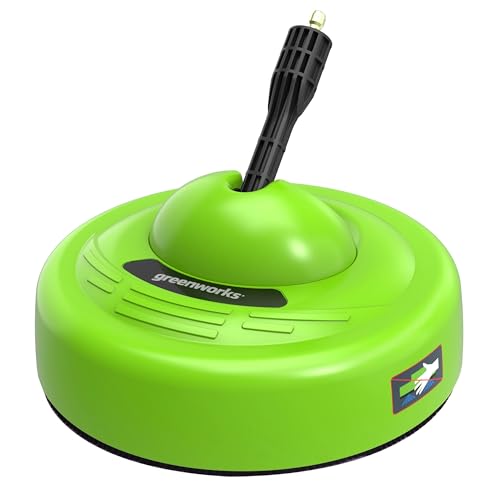
Greenworks 11-Inch Surface Cleaner - Greenworks pressure washing gear

Low-GPM electric machines

Greenworks 11-Inch Surface Cleaner

Greenworks|Our score 8.0/10 ★★★★

Eleven inches is the only size that spins reliably on a 1.2 GPM electric, which makes this the right answer for most Greenworks and Ryobi owners.

What it is

  • 11-inch cleaning width
  • Universal pressure washer attachment

Specs from the Amazon catalog listing.

Our scores

Ease of use
8.8
Capability
7.0
Build
7.0
Value
9.0

Good

  • Works on the 1.2 GPM machines that larger heads stall on
  • Light and easy to steer around furniture legs and planters
  • Cheapest entry into surface cleaning

The trade-off

  • Eleven inches means more passes on a big driveway
  • Mostly plastic construction
  • Can bog down if your pressure is also low
$34.99 - View on Amazon

#ad Price as of October 5, 2026.How this is funded

Sun Joe SPX-SC14 14-Inch - Sun Joe pressure washing gear

The best match for an electric machine

Sun Joe SPX-SC14 14-Inch

Sun Joe|Our score 8.6/10 ★★★★½

Fourteen inches is the sweet spot for an electric unit: wide enough to save real time, narrow enough that 1.6 to 2 GPM still spins it properly.

What it is

  • 14-inch cleaning width
  • Stainless steel housing
  • Four wheels
  • Universal quick-connect fitting

Specs from the Amazon catalog listing.

Our scores

Ease of use
8.6
Capability
8.4
Build
8.4
Value
8.8

Good

  • Spins properly on electric machines that choke a 15-inch head
  • Four wheels keep it flat, which is what stops the stripe pattern
  • Stainless housing instead of plastic at a similar price

The trade-off

  • Still too much for a 1.2 GPM machine
  • The skirt scuffs on rough broom-finish concrete
  • No extension handle in the box
$69.97 - View on Amazon

$79.97 13% off

#ad Price as of October 5, 2026.How this is funded

Simpson 15-Inch Steel Surface Cleaner - Simpson pressure washing gear

Gas machines and big driveways

Simpson 15-Inch Steel Surface Cleaner

Simpson|Our score 8.5/10 ★★★★½

A steel 15-inch head built for a gas unit's water volume - put it on a 1.2 GPM electric and it will barely turn.

What it is

  • 15-inch cleaning width
  • Steel construction
  • 2026 version, part 80299

Specs from the Amazon catalog listing.

Our scores

Ease of use
7.6
Capability
9.0
Build
8.8
Value
8.4

Good

  • Covers ground fast behind a 2.5 GPM gas machine
  • Steel body shrugs off being dropped on concrete
  • Simpson spares are easy to get

The trade-off

  • Needs real GPM - this is the wrong head for most electrics
  • Heavy enough to be tiring on a long session
  • No wheels on some configurations, so it drags
$59.98 - View on Amazon

$99.99 40% off

#ad Price as of October 5, 2026.How this is funded

Common questions

Is a 20-inch surface cleaner worth it?

Only behind a 4 GPM commercial machine. On any homeowner pressure washer it will not spin properly and will clean worse than a 14-inch head.

Should I size up if I have a big driveway?

Size to your machine, not your driveway. A correctly driven 14-inch head will finish a large driveway faster than a stalling 15-inch one.

Does a bigger head need more pressure too?

Flow is the binding constraint, not pressure. More pressure at the same flow gives you a harder jet from a slower bar, which is the wrong trade here.