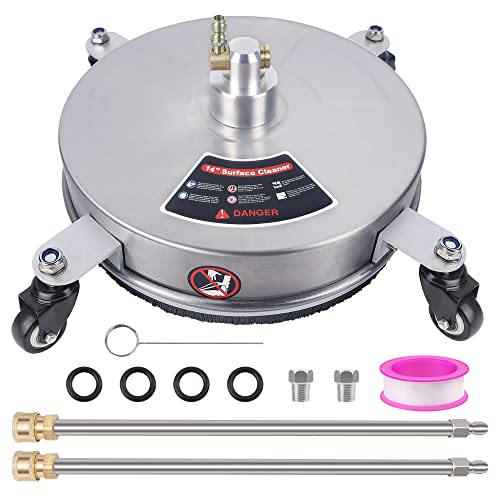
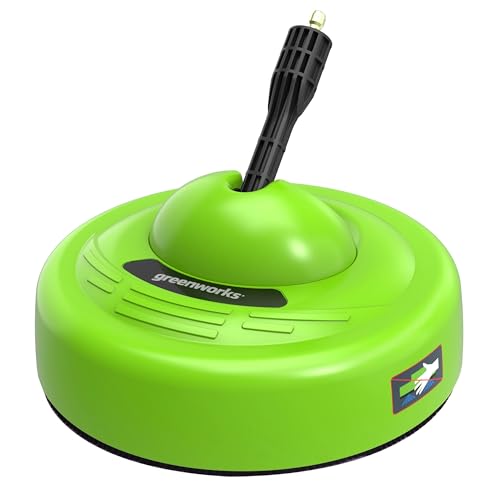
The most common disappointment in this whole category: someone buys a 15-inch surface cleaner because it was only a few dollars more than the 11-inch, bolts it to a 1.2 GPM electric machine, and finds it barely turns. The head is not faulty. It is simply sized for roughly twice the water their machine produces.
This page is the shortlist for electric machines specifically, grouped by the flow rate you actually have.
If your machine does 1.2 GPM
You want 11 inches, and only 11 inches. That covers the Greenworks 1600 and 2000, the Ryobi 1800, and most sub-$180 machines. An 11-inch head means more passes on a big driveway, and it also means the bar spins at a useful speed, which is the difference between a clean disc and a smeared one.
This is not a compromise you can buy your way out of. Pressure does not substitute for flow here — the arithmetic is in PSI vs GPM.
If your machine does 1.6 to 2.0 GPM
Fourteen inches is the sweet spot, and it is a genuinely different experience from 11. That covers the Westinghouse ePX3050 and ePX3500 at 1.76 GPM and the Active 2.0. A 14-inch head at 1.76 GPM spins properly, covers meaningfully more ground per pass, and still steers easily around planters and furniture legs.
A 15-inch head will work at 1.76 GPM but will not spin at full speed, and you will notice it on anything stubborn. If your machine is at the top of the electric range and you want the extra width, the Tool Daily 15-inch is the one to look at — with that caveat attached.
Why four wheels matters more on an electric
With less flow you have less margin, so an unlevel deck shows up immediately as striping. Four wheels hold the housing flat without you thinking about it; three wheels tip over an expansion joint and leave a visible crescent. On a gas machine the extra water partly covers for technique. On an electric it does not.
Check the fitting as well as the size
Most of these heads are 1/4-inch quick connect. Most electric machines’ guns are too, but some use M22 threads, and M22 comes in 14mm and 15mm variants that look identical. A two-dollar adapter solves it, and not having one on the day is why so many of these listings carry a one-star “does not fit” review. See the quick connect guide.
Get more out of less flow
Three things genuinely help on an electric machine. Apply a concrete cleaner and let it dwell before you start — chemistry costs you no flow at all. Work in smaller sections so the cleaner has not dried before you reach it. And go slower rather than pressing harder; the bar needs time at low flow.
Full technique in how to use a surface cleaner, and if your head is barely turning, start here.