Most people assume a surface cleaner is the aggressive option and a wand is the careful one. On wood, composite and pavers it is the other way round, and understanding why changes how you clean a patio.
Why a head is gentler than a wand
A wand concentrates all your machine’s force into a narrow jet that you are holding at whatever distance feels right, and it is stationary relative to the surface for as long as you hold it there. That is exactly the recipe for furring timber and carving a washboard pattern into softwood decking.
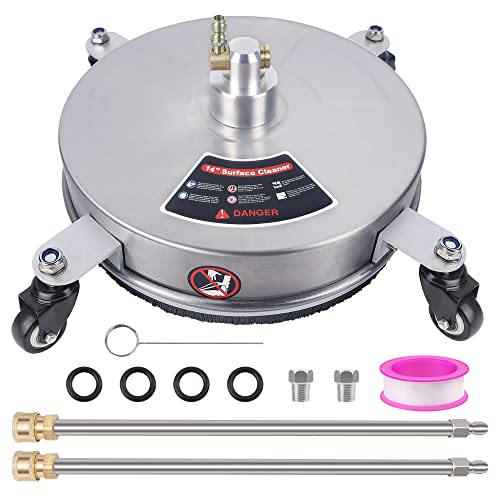
A surface cleaner splits the same water between two or three nozzles on a bar spinning several hundred times a minute, at a fixed height set by the housing. No point on the surface gets more than a fraction of a second of exposure, and you physically cannot hold it in one place. Lower peak force, even coverage, and no technique required.
What to look for on a patio specifically
Smaller is better. Patios have furniture legs, planters, steps and awkward corners. An 11 or 14-inch head steers; a 15-inch one wedges. This is the one place where the small heads win on merit rather than on flow.
Four wheels, and good ones. Paver patios are not flat — there is a lip at every joint. Four wheels ride over them; three tip.
A skirt that does not mark. On pale pavers and composite decking a hard plastic skirt dragged across the surface can leave scuff lines. Keep the head moving and check an inconspicuous area first.
Composite and painted surfaces: use the brush
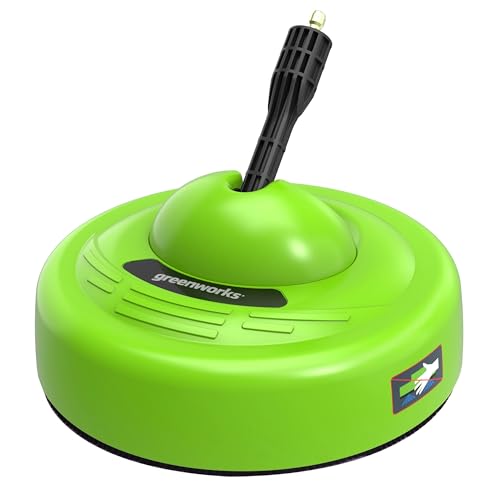
For composite decking, painted boards and anything you are genuinely nervous about, the better answer is not a smaller surface cleaner — it is a rotary brush attachment, which is why one is in the picks here. It does the work mechanically at low pressure, which is the only safe way to clean a surface where the finish is the point.
Most composite manufacturers publish a maximum pressure in their care guidance. Check yours before anything else, and treat it as the limit rather than a suggestion.
Pavers lose their sand. Plan for it.
Any pressure cleaning of a sand-jointed patio will remove some jointing sand — a surface cleaner less than a wand, but still some. Budget for re-sanding the joints afterwards and let the pavers dry fully first. Skipping it means weeds in the joints by next spring.
Method for each surface is in how to pressure wash a patio and how to pressure wash a deck, and the cleaners that do the real work are in patio cleaners and deck cleaners.