Under $400 the pick is the Westinghouse WPX3400 — 3,400 PSI at 2.6 GPM with an onboard soap tank and the gun, wand and nozzle set already in the box. If you do not want an engine to look after, the Greenworks Pro 2300 is the electric to buy instead, and its 2.3 GPM is closer to the gas machine than any electric at a lower price gets.
This is the first budget where you are choosing rather than compromising. Under $200 every option is a light electric. Under $300 a gas machine becomes technically reachable but only just, as a bare unit with no soap tank. At $400 both answers are fully formed, and the page below is mostly about which of the two is yours.
What the extra $100 actually buys over $300
On gas: completeness. The sub-$300 gas machines are frames and engines. The WPX3400 arrives with the soap tank, the spray gun, the wand and the full five-nozzle set, which is the difference between cleaning the house this weekend and ordering parts. It also moves 2.6 GPM against 2.4, and flow is what finishes flat surfaces.
On electric: a certified rating and real flow. Most electrics publish a max PSI measured at the instant the trigger closes. The Greenworks Pro 2300 publishes an SGS certified 2,300 PSI at 2.3 GPM — a measured working figure, and roughly double the water of a typical 1.2 GPM electric. Nothing under $300 does that.
And a hose reel, if you want one. The Karcher K 5 Premium spends its budget on the reel and the build rather than the numbers. Whether that is worth it is a real question, answered below rather than assumed.
Going the other way: the step up to under $500 buys a Honda-class engine or a brushless motor. The capability curve flattens hard above $400, which is why this band is the value sweet spot rather than the $500 one.
The six, as the listings state them
| | Power | PSI | GPM | In the box |
|---|
| Westinghouse WPX3400 | Gas | 3,400 | 2.6 | Soap tank, gun, wand, 5 nozzles |
| Greenworks Pro 2300 | Electric | 2,300 certified | 2.3 | Complete unit |
| Simpson Clean Machine 2900 | Gas | 2,900 | 2.4 | 25-ft hose |
| Karcher K 5 Premium | Electric | 2,000 | 1.4 | Onboard hose reel |
| Sun Joe SPX7000-MAX | Electric | 2,200 | 1.1 | Foam cannon, turbo nozzle |
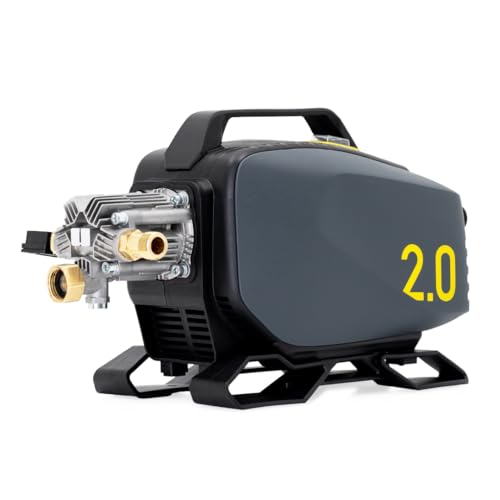
| Active 2.0 GPM | Electric | 1,800 | 2.0 | Tool only |
Read the GPM column before the PSI column. Two of these machines publish more than double the flow of another two, and that is the number that decides whether a driveway takes an hour or an afternoon. The reasoning is in PSI vs GPM explained.
Westinghouse WPX3400 — the one to buy
3,400 PSI at 2.6 GPM is enough to run a 15-inch surface cleaner at full speed, rinse a two-story wall in one pass and finish a long driveway in a morning. The onboard soap tank is the part that makes it unusually house-friendly for a gas unit — no bucket, no injector tube lying in the gravel — and most gas machines at this price omit it.
The costs are real and worth saying plainly: engine oil, fuel stabilizer, winterizing before the first freeze, the noise, and a weight that makes it a two-person lift into a truck. 3,400 PSI will also carve wood and strip paint off siding if you get close with the wrong tip. If none of that puts you off, nothing else here cleans as fast.
Greenworks Pro 2300 — the electric that does not feel like a compromise
2,300 PSI at 2.3 GPM, and the rating is SGS certified rather than a max figure. That combination is why this is the one electric here that can properly drive a 14-inch surface cleaner and keep a soap injector drawing. For a household that wants a driveway cleaned without owning an engine, this is the machine.
It needs a 15-amp circuit to itself and it costs two to three times the entry Greenworks units, so it is overkill if the real job list is a car and some furniture. Buy it for concrete, siding and a patio you actually want finished.
Simpson Clean Machine 2900 — the gentlest gas option
2,900 PSI at 2.4 GPM is the bottom of Simpson’s gas range, and for a homeowner that is a recommendation rather than a compromise: it is already more capability than a house, a driveway and a fence require, and it is the configuration least likely to put a stripe through your siding. It is also the cheapest way onto gas on this page.
There is no onboard detergent tank, so soap means a separate injector or a pump sprayer, and the gas upkeep applies exactly as it does to the Westinghouse. The full write-up is in the Simpson Clean Machine 2900 review.
Karcher K 5 Premium — the one you buy for the reel
2,000 PSI at 1.4 GPM with the hose wound onto the machine rather than coiled on the floor. If the thing that stops you using a pressure washer is the fifteen minutes of untangling at each end, that reel is worth more to you than 300 PSI, and this is the honest reason to buy it.
On numbers alone it is beaten here. 1.4 GPM will not drive a 15-inch surface cleaner properly, and it costs roughly three times the entry Karcher while cleaning nowhere near three times better. The reel also makes it the least storable machine on the page.
Sun Joe SPX7000-MAX — the budget pick
The cheapest machine on this page, with a foam cannon and turbo nozzle already included, which is a genuine saving if you were going to buy both anyway. 2,200 PSI is plenty for cars, furniture, bins and siding.
The number to look at is 1.1 GPM. That is a car-and-furniture flow rate: it will not spin a surface cleaner and it rinses slowly, so a large flat area is the wrong job for it. Buy it as the complete car-washing setup it actually is rather than as a cheap driveway machine.
Active 2.0 GPM — the specification trap
On paper the most interesting electric here: 2.0 GPM at a modest 1,800 PSI is exactly the right trade for flat surfaces. The catch is in the listing — it is sold tool only, so you supply the hose, the gun and the tips, and the real delivered cost lands above several gas machines on this page.
It earns its place as an excellent second machine for someone who already owns the accessories, and it is the wrong first purchase. Worth knowing before the price tempts you.
Gas or electric at this budget
Buy gas if the deciding job is a long driveway, a large patio or a fence line, and you are willing to own an engine: oil, fuel, winterizing, noise and storage space. You get roughly double the water and the job takes a fraction of the time.
Buy electric if the jobs are a car, siding, decking and a normal patio, or if the machine has to live indoors, start with a switch and be used by anyone in the house. At this budget the electric option is strong enough that the gas advantage only shows on large flat concrete. The full argument is in electric vs gas pressure washers.
What to budget beyond the machine
At this price the machine is most of the purchase but not all of it. A surface cleaner is the single biggest time saver on flat concrete and the gas machines here will drive a 15-inch head properly. Fifty feet of hose means moving the unit far less. And a bottle of pump saver before the first freeze costs a fraction of the pump it protects.
What a machine at this price should arrive with
Below $300 an incomplete machine is the norm and you plan around it. At $400 it is a reason to pick a different one, because the gap between a complete unit and a bare one is a real fraction of the budget.
A full nozzle set. Four or five quick-connect tips covering 0, 15, 25 and 40 degrees plus soap. Buying these separately is not expensive but it is a delay, and a machine shipped with one general-purpose tip will be used with that tip on everything, which is how siding gets damaged.
Somewhere for the detergent. Either an onboard tank or a working siphon. A machine with neither means a separate injector, and most people simply never buy it and end up relying on pressure to do work that chemistry does better and more cheaply.
Hose you can live with. Twenty-five feet is the common figure and it is short. It is not a reason to reject a machine, but budget for fifty feet if the furthest thing you clean is more than a few steps from the tap.
Three mistakes at this budget
Buying gas for a job electric finishes. An engine is a commitment of roughly an hour a year in maintenance and a permanent piece of garage floor. If the deciding job is a car, a deck and a normal patio, the gas machine will be the thing you avoid getting out.
Buying the highest PSI in the band. At $400 the highest-pressure option is also the one most likely to damage siding, decking and anything painted. More pressure is a narrower margin for error, not a better machine.
Spending the whole budget on the machine. A surface cleaner, a longer hose and a bottle of pump saver change the ownership experience more than the last $60 of machine does. Budget around $350 of machine and the rest of it on the parts that make the machine usable. If that means dropping a tier, the comparison is on best pressure washers under $300, and several of those machines are genuinely enough.
What I would buy
A long driveway and a big house: Westinghouse WPX3400.
Everything the gas machine does, without the engine: Greenworks Pro 2300.
Gas, but gentler and cheaper: Simpson Clean Machine 2900.
Least money, and the car is the real job: Sun Joe SPX7000-MAX.
If $400 is above where you wanted to be, the honest comparison is best pressure washers under $300 — less complete, and for many households still enough.