Washing an RV is not washing a big car. A motorhome or travel trailer is four or five times the surface area of a sedan, most of that surface is twelve feet off the ground, the sidewalls are thin fiberglass or aluminum over a lightweight frame, the graphics are vinyl decals that will lift at the edge, and the roof is almost certainly a rubber membrane that a strong detergent will slowly destroy.
Every one of those facts pushes the same direction: you want less pressure than you would use on concrete, more water than a small machine delivers, and more reach than a pressure washer alone can give you. That is the shape of this list.
What I picked for, in order
1. Flow, because the area is enormous. A 32-foot trailer has roughly 600 square feet of sidewall before you count the roof. Rinsing that with 1.1 GPM is an afternoon of standing still. Flow is what carries soap and road film off a panel, and on a vehicle this size it is the single biggest difference between a two-hour job and a five-hour one. The reasoning is in PSI vs GPM explained.
2. Low working pressure, or a way down to it. RV sidewalls, seals, windows, vents and decals all want roughly 1,200 to 1,600 PSI at the panel. That is lower than most machines produce at the trigger, so what you actually need is either a low-pressure machine or a wide nozzle and the discipline to use it. A 40-degree white tip at two feet is safe on a coach; a 15-degree yellow tip at six inches will peel a decal and drive water past a window seal.
3. A real detergent path. On an RV the soap does nearly all the work. Road film, diesel soot and oxidation do not come off with water at any pressure you dare use, and the chalky gray streaks down the sides are oxidized roof sealant that has to be dissolved rather than blasted. A machine with an onboard tank or a working siphon is worth more here than extra PSI.
4. Reach without a ladder. This is the one that actually hurts people. The temptation is to stand on the ground and point the wand up at the roofline, which drives water up under the gutter rail and the window trim — exactly the places an RV leaks from. The fix is a telescoping brush, not more pressure.
5. Working away from a faucet. Plenty of RV washing happens at a storage lot or a campsite with no spigot and no outlet. One machine on this list draws from a bucket and runs off a battery, which is the only honest answer to that problem.
The pressure limits that matter
Sidewalls and front cap: 1,200 to 1,600 PSI with a 25 or 40-degree tip, held at least 18 inches off the panel. Fiberglass takes this happily; the risk is not the skin but what is behind it.
Decals and graphics: treat the edges as the weak point and never aim straight at one. Work the spray along a decal rather than into it. A lifted corner becomes a peeled panel graphic within a season of highway driving.
Windows, vents, doors and the gutter rail: never point up into a seam. Spray down and across. Water driven upward past a seal does not announce itself — you find out about it as a soft floor two years later.
The roof: do not pressure wash a rubber roof at all. EPDM and TPO membranes are soft, the seams are sealed with lap sealant, and both can be damaged by a jet that would not mark the sidewall. A roof gets a soft brush, a membrane-safe cleaner and a gentle rinse. The same principle as soft wash vs pressure wash.
Awnings: extend them, wash with a soft brush and rinse at low pressure, and let them dry fully before rolling up. A rolled wet awning grows mildew in days.
Slide-out seals and the underside: leave the seals alone and keep the jet off them. The underside and the wheel wells are the only places on an RV where you can use real pressure without worrying.
Why the pick is a mid-pressure electric
The machine I would put in front of most RV owners is a 1.7-ish GPM electric with an onboard soap tank and a five-tip nozzle set. The flow gets you through the panel area in reasonable time, the soap tank means you can foam a section and let it dwell, and the nozzle set is how you get the pressure down to where a coach wants it.
Electric rather than gas, for three reasons. RV washing happens in storage lots and campgrounds where engine noise is a problem and sometimes against the rules. The flow you need is comfortably inside what a 15-amp electric delivers. And a gas machine’s extra pressure is a liability on a vehicle like this — you would spend the whole job avoiding it. The general comparison is in electric vs gas.
If you also wash a car, the same machine does both, and the paint-safety numbers are in what PSI to wash a car. An RV is more forgiving than clearcoat on the flat panels and much less forgiving at the seams.
When the battery machine is the right answer
If your RV lives in a storage lot, there is a good chance there is no faucet and no outlet anywhere near it. A cordless unit that siphons from a bucket solves that, and nothing else does.
Be clear-eyed about what it is: a few hundred PSI, a battery measured in minutes, and a bucket that empties faster than you expect on a vehicle this size. Nobody washes a 35-foot coach end to end with one. What it is genuinely good for is the back cap, the wheels, the steps and a bug-covered front after a trip — and doing that where there is no water supply at all. The wider category is in best cordless pressure washers.
The telescoping brush is not optional
A 20-foot brush on a pole is the single best purchase on this page and it is the cheapest. It gets the roof edge, the upper sidewall and the front cap without a ladder, it lets you agitate soap rather than trying to blast dirt off, and it keeps you from pointing water upward into the one set of seams you most want to keep dry.
The method is: wet the panel, apply soap low to high, brush in sections top to bottom, and rinse high to low before it dries. A flow-through brush that takes a garden hose is fine here — you do not need pressure to carry soap, you need contact. The other long-handled options are in best outdoor cleaning brushes.
Two soaps, not one
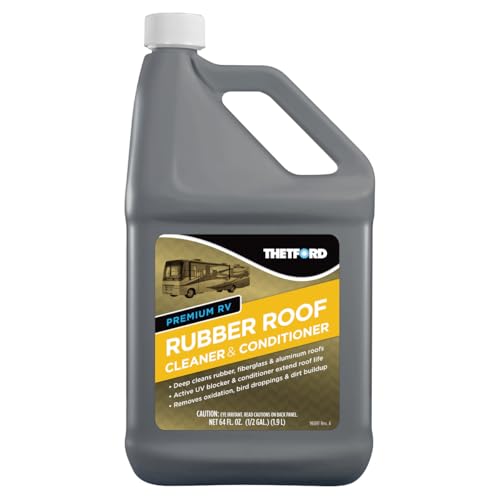
An RV needs two chemicals and people usually buy one. A pH-neutral body soap for the panels, because it will not strip wax or dull a gel coat and it is safe on decals. And a rubber-roof-specific cleaner for the top, because general-purpose house wash and citrus degreasers break down EPDM membranes over time.
What to keep away from an RV entirely: bleach-based house wash, which attacks roof membranes and aluminum trim; anything acidic, which will stain and etch; and automotive degreasers on painted or decaled surfaces. The reasoning behind the bleach warning is in bleach and pressure washers, and mixing ratios generally are in house wash mix ratios.
Black streaks are their own problem. They are oxidized sealant washing down off the roof edge, not dirt, which is why they come back after every rain until you clean and treat the roof itself. Washing the sides harder achieves nothing.
What I left out, and why
Gas machines. More pressure than an RV should ever see, loud in exactly the places people wash RVs, and no faster on the job because the limit is your reach, not your water. If you need one for other work, see best gas pressure washers and fit a wide tip before you point it at a coach.
Turbo nozzles. A rotating pencil jet is the single worst thing you can put on an RV. It will mark fiberglass and lift a decal instantly. They are excellent on concrete — see best turbo nozzles — and they have no business on a vehicle.
Surface cleaners. Flat-surface tools for horizontal concrete. There is nothing on an RV they fit.
Roof-cleaning attachments that mount on a wand. The whole point is to keep high pressure off the membrane. A brush does this job and a wand attachment reintroduces the risk.
The order I would buy in
Telescoping brush and two soaps first — they are cheap, and with a garden hose alone they will already get you most of a clean RV. Then the machine, for the rinse and the lower panels. Then a 50-foot hose, because a pressure washer parked at the faucet and a trailer parked across a lot are rarely close together.
Before the first wash, read pressure washer safety for beginners and surfaces you should never pressure wash. Nearly every expensive RV washing mistake is a seam that got sprayed upward or a roof that got treated like a driveway.