Cordless pressure washers are the most misunderstood category on this site, and the misunderstanding is mostly the fault of the listings. They are photographed like pressure washers, named like pressure washers, and a large number of them produce a fifth of the pressure of the cheapest corded machine in the same aisle. Buy one expecting to clean a driveway and you will be back at the returns desk.
Buy one expecting what it genuinely does — washing a car in a parking space, rinsing a bike or a dog or a kayak, cleaning patio furniture, working somewhere with no tap and no socket — and it is one of the more satisfying tools you can own. This page sorts the current range by what each model can actually clean, and says plainly where the cord still wins.
The number that matters, and why the listings hide it
A cheap corded electric pressure washer produces somewhere between 1,600 and 2,500 PSI. A typical handheld cordless unit produces 320 to 609 PSI. That is not a small difference in degree; it is a difference in what the tool is for. At 320 PSI you are closer to a strong garden hose with a good nozzle than to a pressure washer.
Flow is the other half, and it is worse. Corded machines run 1.2 to 2.0 gallons per minute off the mains. A battery unit siphoning from a bucket is typically well under that, and the bucket is finite, which is the constraint nobody mentions in the reviews: a five-gallon bucket at even one gallon per minute is five minutes of trigger time.
You will notice how many listings in this category lead with battery voltage — 20V, 24V, 40V — rather than PSI. Voltage tells you nothing about cleaning power. It is the number that is available when the useful number is not flattering. If a listing gives you volts and no pressure figure, assume the pressure figure is low. The underlying arithmetic is in PSI vs GPM explained.
What I picked for
An honest pressure figure in the listing. Every machine on this page publishes one, or publishes a flow figure and is clear about what it is for. Anything advertising only a voltage was left off.
A battery platform you might already own. This is the single biggest value lever in the category. A bare tool on a platform already in your garage is a fraction of the cost of a kit, and the battery is the expensive part. WORX Power Share, Greenworks 60V and EGO 56V all span mowers, blowers and trimmers.
Whether it will draw from standing water. The siphon hose is the actual superpower here. A machine that can pull from a bucket, a water butt, a lake or a camping jerrycan can work where no other pressure washer can. One that insists on a mains hose connection has thrown away most of the reason to go cordless.
Run time you can plan around. Battery units are rated in minutes, and the honest ones say so. A 2.0Ah pack is a demonstration; a 4.0Ah or 6.0Ah pack is a session. If a kit ships with the smallest battery in the range, that is a cost deferred, not avoided.
Weight in the hand. Unlike a corded machine, you hold this one. Add a large battery to a brushless motor and a nozzle and you are holding two to three pounds at arm’s length for the whole job.
The three tiers, and which one you want
Handheld rinsers, roughly 300 to 400 PSI. The WORX Hydroshot sits here. It is light, it runs off a bucket, and it is the right answer for cars, bikes, muddy boots, kayaks, dogs and patio furniture. It will not clean concrete, and no nozzle or soap changes that.
Handheld cleaners, roughly 600 PSI. The WORX WG633 and WG647 are the current examples. Double the pressure of the tier below is enough to shift real grime from furniture, garden tools, wheelie bins and wheel arches. Still not a concrete tool, but a genuinely different experience from a 320 PSI unit.
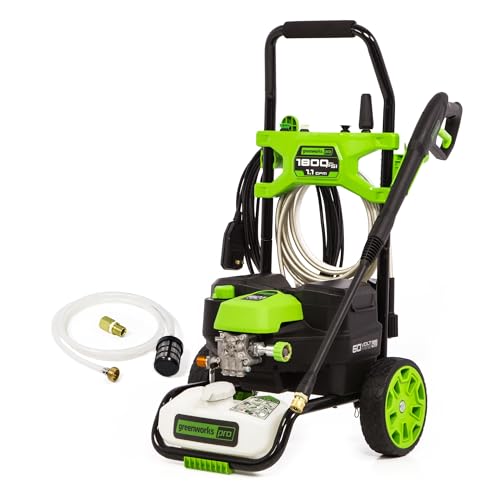
Battery pressure washers, 1,800 PSI and up. The Greenworks 60V and the EGO HPW2105 are proper machines that happen to run on a battery. They will clean a patio and siding. They also cost two to five times what an equivalent corded machine costs, and they are heavy. If you own the battery platform already, the gap narrows a lot.
When a cord is simply the better buy
If the thing you want to clean is attached to your house and there is a socket within 50 feet of it, buy corded. A sub-$200 corded machine will out-clean every handheld on this page by a factor of four, will never stop mid-job to recharge, and will run a surface cleaner. The honest case for cordless is mobility and water independence, not cleaning power.
The one exception worth naming: an extension cord is a real limitation and a real hazard if you get it wrong. If the reason you are looking at cordless is that your only socket is a long way off, read extension cord for a pressure washer first — a correctly rated cord is cheaper than solving the problem with batteries.
What cordless is genuinely best at
Washing a car where there is no tap. Apartment parking, a shared driveway, a campsite. Two buckets and a handheld unit is a complete car wash. Pressure at this level is also inherently paint-safe, which removes the main anxiety beginners have about pressure washing a car — see what PSI to wash a car.
Anything muddy, away from the house. Mountain bikes, dirt bikes, dog paws, fishing gear, boat trailers. The bucket siphon is what makes this work.
Small, frequent jobs. The real advantage over a corded machine is not power, it is that you will actually use it. A unit you grab for four minutes gets used weekly; a machine that needs hoses, a socket and twenty feet of setup gets used twice a year.
Rinsing soap off. If you foam a car with a foam cannon on a corded machine, a handheld cordless unit is a pleasant way to do the rinse without dragging the machine round the car a second time.
What it will not do, honestly
It will not clean a driveway, a patio slab or a concrete path at any speed worth your afternoon. It will not strip algae from siding. It will not run a surface cleaner, because surface cleaners are turned by flow and there is not enough of it — see will a surface cleaner work on my pressure washer. And a turbo nozzle on a 320 PSI unit does nothing at all.
It will also not run continuously. Most handhelds warm up and most batteries are flat inside 15 to 25 minutes of trigger time. Plan the job in sections, or buy a second battery at the same time as the tool — it is the accessory that changes the experience most.
Soap, and the mistake to avoid
Low-pressure units are actually good at applying soap, because low pressure is exactly what a detergent wants. The mistake is the soap itself: most of these tools have a small bottle and no injector, so a thick concentrate will not draw. Use a dilute car shampoo or a ready-to-use cleaner rather than a heavy concrete concentrate.
Never put bleach-based house wash through a battery unit with an internal pump and no way to flush it. Rinse the pump with clean water after anything but plain shampoo. The general rules are in do I need pressure washer soap.
Buying order, if you are starting from nothing
If you own no outdoor power tools and want one cleaning machine, buy a corded electric and read best pressure washers for beginners. Add a handheld cordless later if the car-at-the-campsite problem is a real one for you.
If you already own a battery platform, buy the bare tool on that platform. It is the cheapest genuinely useful purchase in this whole category, and the battery you already have is doing the work.
If what you actually want is a proper pressure washer without the cord, the 1,800 to 2,100 PSI battery machines will do it, but go in knowing what it costs — and look hard at the Greenworks dual-power design, which plugs in when a socket is available and runs on the pack when it is not. That is the compromise that makes most sense at this price. For what the money buys corded, compare against the best electric pressure washers.