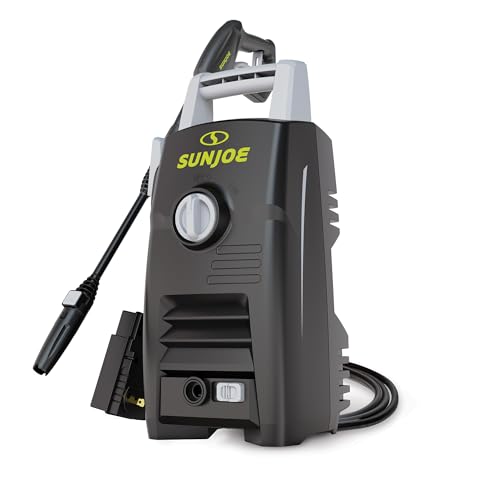
The best small pressure washer for most people is the Sun Joe SPX100-GO: 1,800 max PSI in a body with a telescoping handle, a detergent tank and a foam cannon already in the box, light enough to carry out one-handed and narrow enough to live in a closet. If the budget is the binding constraint rather than the space, the Greenworks 1600 is the cheapest machine here that still does real work.
“Small” is a storage question that gets answered with a pressure figure, and that is why so many people buy badly. A machine is in your hands for perhaps three hours a year. It is in your hallway, your closet, your balcony box or the one clear square foot of your shed for the other 8,757. This page ranks on the second number.
What makes a pressure washer genuinely small
Footprint, not weight. Most homeowner electrics weigh between 16 and 30 pounds, which is a difference you notice once a year. Footprint is the difference you notice every time you put it away. An upright machine with a narrow base slides behind a door; a wide-stance wheeled frame does not.
Whether the handle collapses. A telescoping or folding handle is the single feature that moves a machine from “lives on the floor” to “lives on a shelf”. It is rarely in the headline specification and it changes the ownership experience more than 300 PSI does.
Whether the hose and cord stow on the machine. Onboard hooks are the difference between one object and three. A machine with nowhere to wrap 20 feet of hose becomes a tangle in a bag, and the tangle is what stops people getting it out.
Whether it can draw from a bucket. This is the apartment and balcony question. A machine that insists on a garden hose connection is unusable where there is no outdoor tap, no matter how compact it is. Only one machine on this page does it.
Enough flow to be worth getting out. Small does not have to mean feeble, but it does have a floor. Below roughly 1.0 GPM you are rinsing rather than cleaning, and the reason is arithmetic rather than opinion — it is set out in PSI vs GPM explained.
The six, as the listings state them
| | PSI | GPM | Power | Stows |
|---|
| Sun Joe SPX100-GO | 1,800 max | Not published | Corded | Telescoping handle |
| Greenworks 1600 | 1,600 | 1.2 | Corded | Compact upright |
| Karcher K1800PS Cube | 1,800 | 1.2 | Corded | Cube, shelf-friendly |
| Greenworks 1500 | 1,500 | 1.2 | Corded | Compact upright |
| WORX Hydroshot WG620 | 320 | Not published | 20V battery | Handheld |
| Sun Joe SPX205E-XT | 1,600 max | Not published | Corded | Compact upright |
Every figure there is the one the machine’s own listing publishes. Where a listing does not state flow, this page says so rather than filling the gap — and a missing GPM figure is itself information, because manufacturers publish the number when it flatters them.
Sun Joe SPX100-GO — the one to buy
This is the machine that solves the actual problem. The telescoping handle drops it to a height that fits a closet shelf, the detergent tank and foam cannon are already included so there is no second purchase to store beside it, and 1,800 max PSI is enough for patio furniture, a car, a bike, bins, a balcony floor and the bottom four feet of siding.
The trade-off is the one every compact machine makes: the listing does not publish a flow rate, and on a machine this size the honest expectation is that you are buying a car-and-furniture tool rather than a driveway tool. A long concrete drive will take an afternoon. For that job, the right answer is on best pressure washers for driveways, not here.
Greenworks 1600 — the budget pick
The cheapest machine on this page and the cheapest on the whole site that still does real work. 1,600 PSI at 1.2 GPM, a compact upright frame, and nothing clever anywhere. For a first machine that has to live in a small space and cost very little, this is the sensible floor — and 1,600 PSI is low enough that it is also the hardest machine here to damage something with, which matters if the first thing you point it at is your own car.
What you give up is reach and comfort. The hose is short, the frame is light enough to get dragged over when the hose is taut, and there is no detergent tank worth the name. The full write-up is in the Greenworks 1600 review.
Karcher K1800PS Cube — the shelf-shaped one
The Cube exists for exactly one reason and it is the reason this page exists: it is a box. Flat top, flat sides, nothing protruding, so it stacks and it sits on a shelf instead of owning a patch of floor. 1,800 PSI at 1.2 GPM puts it level with the Sun Joe on capability.
You pay for the shape. It costs meaningfully more than the Greenworks units at the same flow rate, and a cube has no wheeled handle to drag, so you carry it — fine across a balcony, less fine down a long drive. Buy it when the storage shape is the deciding factor and you already know it is.
Greenworks 1500 — the smallest corded machine worth owning
1,500 PSI at 1.2 GPM with the rating stated as PWMA certified, which is worth more than it sounds: a certified figure is a measured working number rather than a ceiling recorded at the instant the trigger closes. A certified 1,500 often feels stronger at the nozzle than an uncertified “max 1,800”.
It is the gentlest full-size machine here, which makes it a good match for someone whose jobs are a car, garden furniture and a small paved area, and a poor match for anyone with set-in concrete staining. Stock on this listing has been thinner than the others, so check before planning a weekend around it.
WORX Hydroshot WG620 — the one that needs no tap
The only machine on this page that works where there is no outdoor faucet. It runs off a 20V battery and siphons from a bucket, a water butt or a jerrycan, which makes it the apartment, campsite and shared-parking answer rather than a compromise.
Be clear about what 320 PSI is: roughly a fifth of the cheapest corded machine here. It rinses a car, a bike, muddy boots, a dog and patio furniture very well and it will not clean concrete at any speed worth your afternoon. Bought for the right job it is excellent; bought as a cheap pressure washer it is a returns-desk visit. The wider battery category is in best cordless pressure washers.
Sun Joe SPX205E-XT — the cheapest way to a real nozzle set
A compact upright with a GFCI plug and a quick-connect nozzle set, usually the lowest price on this page. It is a rinsing-and-furniture machine rather than a concrete machine, and the short hose keeps you working close to the unit, which on a balcony is irrelevant and on a driveway is annoying.
What small costs you
Every machine on this page trades flow for size, and flow is what finishes flat surfaces. That has two practical consequences worth knowing before you buy rather than after.
A surface cleaner will not spin properly. The attachment that turns a three-hour patio into a thirty-minute one needs water volume to rotate. At 1.2 GPM an 11-inch head is the realistic ceiling and anything larger will stall. The fit question is worked through in will a surface cleaner work on my pressure washer.
Chemistry does more of the work. With less water moving, dwell time matters more. A house wash or patio cleaner left to work for five to ten minutes does what another 500 PSI will not, and it is cheaper than a bigger machine. The picks are in best pressure washer detergents.
Three ways people buy the wrong small machine
Shopping on PSI alone. Two machines on this page publish 1,800 PSI and one of them is a handheld that produces 320. The headline number is the one every listing leads with because it is the one that sounds biggest, and on compact machines it is the least informative figure available. Read the flow rate, and where no flow rate is published, read that absence as a flow rate.
Buying a cordless unit expecting a corded one. The battery machines in this size class are rinsing tools. That is a genuine category with genuine uses - a car in a shared parking space, a muddy bike, a dog, a kayak at a trailhead - and it is not the same tool as a 1,600 PSI corded machine at a similar price. If there is an outdoor socket within reach, corded wins on every count except mobility.
Forgetting the hose has to live somewhere too. A compact machine with twenty feet of stiff high-pressure hose and a twenty-five foot power cord is three objects, not one. Onboard hooks, a hose that coils without fighting and a gun that clips to the frame decide whether the machine ends up back on the shelf or in a heap behind the door.
What to check before you order
Your outdoor socket. Every corded machine here wants a grounded outdoor outlet, and the ones at the top of the page are happier on a circuit that is not also running a freezer. Extension cords are the usual cause of a machine that cuts out under load - if yours has to run more than a few feet, read the extension cord guide before the first use rather than after.
Where the water comes from. A garden tap that delivers a weak trickle will starve any of these machines regardless of its rating, because a pressure washer can only pressurize the water it is given. If the supply is slow, the bucket-fed Hydroshot is not a compromise - it is the only honest option on the page.
What you are actually going to clean. Write the list down. If it is a car, bikes, bins, furniture and a small paved area, every machine here will do it and you should buy on storage shape and price. If the list has the word driveway in it, the right page is best pressure washers for concrete and the right machine is bigger than anything here.
What I would buy
A closet, a balcony and a car: Sun Joe SPX100-GO.
The least money for a machine that still works: Greenworks 1600.
It has to sit on a shelf: Karcher K1800PS Cube.
There is no outdoor tap at all: WORX Hydroshot WG620, and buy a second battery with it.
If after reading this the honest answer is that you need more machine than a small one, the step up is best pressure washers under $200 — the same budget, a bigger footprint, noticeably more water.