Physically yes, sensibly no. Dish soap will go through a pressure washer and it will produce suds, but it is formulated for a sink rather than a pump: it foams excessively in the wrong places, it has no dwell behavior on a vertical surface, it strips wax off a car, and on some machines the surfactants are explicitly excluded by the manufacturer. A bottle of proper outdoor concentrate costs about the same as a large bottle of Dawn and cleans several times better.
This is one of the most common beginner questions in the category, and the honest answer is not “it will destroy your machine instantly”. Plenty of people have done it without an immediate failure. The case against it is that it does not work very well and it carries real risks, both of which are avoidable for very little money.
The five specific problems
1. It foams in the pump, not on the wall. Dish detergent is engineered to produce a large volume of fine, stable foam when agitated in water. A pressure washer pump is a water agitator. Foam in a pump means air in the pump, and air in the pump means cavitation, pressure loss and seal wear. It is also the reason a machine can start to surge and pulse after a soapy job.
2. It does not cling. Outdoor cleaners are built to stay wet on a vertical surface long enough to break the bond between the surface and the dirt. That is the whole mechanism, and it is called dwell. Dish soap sheets off siding in seconds, so nothing dwells and you end up compensating with pressure — which is how siding gets damaged.
3. It has no biocidal action. The stain on a shaded wall or a north-facing patio is a living organism. Dish soap removes the visible layer and leaves the organism, which is why the green comes back within weeks. Oxygenated and mold-specific cleaners address it.
4. On a car, it strips your protection. Dish soap is designed to remove grease, and wax and sealant are grease. Washing a car with it removes months of protection in one pass and leaves the paint unprotected and squeaky. A pH-neutral car soap exists precisely to avoid this.
5. Some manuals exclude it. Several manufacturers specify that only approved pressure washer detergents go in the tank, and failures traced to other chemicals are not covered. Check yours before you decide the risk is theoretical.
What to look for in the bottle you buy instead
The words “for pressure washer use” on the label. This is not marketing; it means the surfactant package was chosen to work through a pump and an injector without excessive foaming.
Concentrate, not ready-to-use. You are paying to ship water otherwise. A 128 oz concentrate makes many gallons of working solution, which is why the cost per job is lower than dish soap even when the bottle costs more.
Surface match, or an honest all-rounder. A concrete cleaner on concrete and a wood cleaner on wood will beat any general-purpose product. If you only want one bottle, buy the all-rounder and accept that it loses on heavy mildew.
Where the run-off goes. Everything you spray on a wall lands in the beds below it. An oxygenated, EPA Safer Choice recognized cleaner is a materially different proposition from bleach in that respect — see bleach and pressure washers.
pH neutral, for cars specifically. This is the single spec that matters on paint, because it is what protects the wax or sealant you already have on there.
The three bottles that replace it
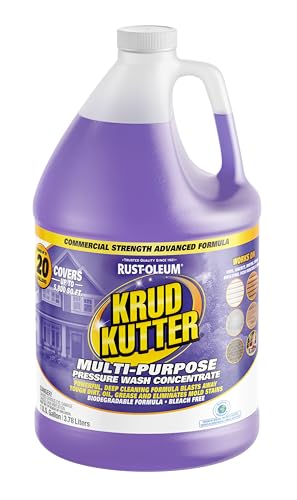
Krud Kutter Multi-Purpose Concentrate is the cheapest competent all-rounder here — a multi-purpose outdoor concentrate rated for pressure washer and manual use, at the lowest cost per gallon of mixed cleaner on the site. If the appeal of dish soap was “I already have it and it is cheap”, this is the direct replacement.
Simple Green Oxy Solve Total Outdoor is the one bottle for a whole house: oxygenated chemistry, EPA Safer Choice recognized, rated for pressure washer and manual use, and it covers siding, concrete, wood and furniture. Oxygenated means it actually does something about algae rather than just rinsing it.
Turtle Wax Pure Wash is the car answer: pH neutral and foaming, cheap, and on the shelf at any auto parts store. It will not strip the wax you paid for. If you want thick foam in a cannon rather than a bucket, the options are in best foam cannon soaps.
How to actually apply it
Detergent goes on at low pressure through the black soap nozzle or the detergent tank, bottom to top on a wall so it does not run through dry dirt and streak. Then you wait — the time stated on the bottle, usually several minutes, keeping the surface wet so it does not dry. Then you rinse, top to bottom, at whatever pressure the surface tolerates.
Almost everyone skips the waiting, and skipping it is what makes people believe soap does not work and pressure does. The mix ratios and the full sequence are in house wash mix ratios. If your soap is not drawing at all, that is usually a nozzle rather than a chemical problem — see soap injector not working.
What about the foam cannon?
Same answer, more emphatically. A foam cannon multiplies whatever you put in it, so dish soap in a cannon means a lot of foam that strips wax and sheets off before it does anything. Cannons also have a small orifice that dish soap’s viscosity does not suit. Use a soap sold for cannon use and the foam will be thicker, cling longer and leave the paint protected. See foam cannon soap ratio.
The short version
Dish soap is the wrong tool and the saving is close to zero. Buy one concentrate for the house and one pH-neutral soap for the car, use the soap nozzle, and let it dwell. That is the entire upgrade, and it will change your results more than a more powerful machine would. The full shortlist by surface is in best pressure washer detergents, and the case for using any soap at all is in do I need pressure washer soap.