Under $150 the pick is the Westinghouse ePX3050, and the reason is one number: 1.76 GPM. Almost everything else on this shelf moves 1.2 gallons a minute. Flow is what carries loosened dirt off a surface, so a machine with half again as much water finishes the same patio in noticeably less time — and here that difference costs nothing extra.
This is the shelf most first machines come from, so it is worth being blunt about what it is. Under $150 you are buying a universal-motor electric with a plastic inlet, a 20-to-25 foot hose and a pump rated for occasional use. That is genuinely enough for cars, patio furniture, bins, steps, a grill, a fence panel and vinyl siding. It is not enough to get through a stained two-car driveway in an afternoon, and no amount of PSI on the box changes that.
The six, as the listings state them
| | PSI | GPM | In the box | Best at |
|---|
| Westinghouse ePX3050 | 2,100 max | 1.76 max | Foam cannon | Everything this budget can do |
| Sun Joe SPX100-GO | 1,800 max | Not published | Foam cannon, detergent tank | Cars and patio furniture |
| Greenworks 1600 PSI | 1,600 | 1.2 | Nozzle tips | Being hard to damage anything with |
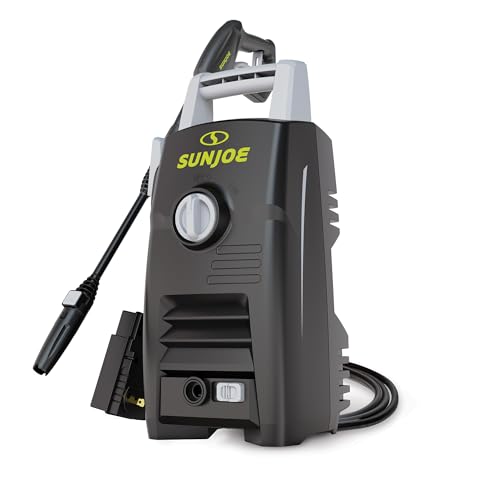
| Sun Joe SPX205E-XT | Not published | Not published | Adjustable wand, GFCI cord | The lowest price that still works |
| Ryobi 1800 PSI | 1,800 | 1.2 | Gun, wand, tips | Houses that already own Ryobi tools |
| Greenworks 1500 PSI | 1,500 (stated PWMA certified) | 1.2 | Nozzle tips | The gentlest option here |
Three of those cells say “not published”. That is deliberate. Where the Amazon listing does not state a figure, nothing gets filled in from memory — and a missing GPM is worth noticing, because on this shelf flow is the spec that decides how long a job takes. PSI vs GPM explained is the five-minute version of why.
What I picked for, in order
1. Published flow. Every machine here sits in the same narrow pressure band, roughly 1,500 to 2,100 PSI, which is plenty for everything a homeowner points a pressure washer at. So pressure is not the differentiator — water volume is. One machine on this list publishes 1.76 GPM, and it is the one I would buy.
2. A box you do not have to top up. At this price a foam cannon or a detergent tank included is worth more than 300 extra PSI, because soap does most of the cleaning people credit to pressure. Two of these include one. If yours does not, start with do I need pressure washer soap.
3. Weight and storage. The strongest predictor of whether a cheap pressure washer gets used is whether it is annoying to get out. Everything here is light enough to carry one-handed, and the three smallest live on a shelf rather than a garage floor.
4. Forgiving pressure. A beginner’s first mistake is usually damage, not disappointment: a 15-degree tip too close to cedar, or a stripe etched into soft concrete. Nothing on this list has enough pressure to make that mistake expensive, which is a real argument for buying cheap first. The per-surface numbers are in what PSI pressure washer do I need.
5. Actually in stock. Every machine below was on sale with a live price the day this page was written. One better-specified unit was left off because it was down to a single unit in stock, which is how this shelf behaves — cheap models churn constantly.
Westinghouse ePX3050 — the pick
2,100 max PSI and 1.76 max GPM, with a foam cannon in the box and a steel frame rather than an all-plastic one. The flow figure is the whole argument: 1.76 GPM is close to half again what the 1.2 GPM machines move, and that is the difference between rinsing a patio and pushing the dirt off it. It is also roughly the flow at which a soap injector and an 11-inch surface cleaner behave properly instead of stalling.
Honest con: both headline numbers are maximums, so treat 2,100 PSI as a ceiling rather than working pressure. And a steel frame on a light machine still tips if you drag it by the hose — move it by the handle.
Sun Joe SPX100-GO — the complete car setup
1,800 max PSI, a foam cannon and an onboard detergent tank, on a frame with a telescoping handle that makes it the easiest unit here to get out and put away. For a car, a set of patio furniture and a dozen steps, this is a finished setup out of one box: soap on, dwell, rinse off, done.
Honest con: Sun Joe does not publish a GPM for it, so you cannot size a surface cleaner to it before it arrives, and the compact frame tells you what it is for — a patio and a car, not 800 square feet of driveway.
Greenworks 1600 PSI — the hardest one to damage anything with
1,600 PSI at 1.2 GPM, light enough to carry up steps one-handed, and low enough pressure that car paint and window seals are simply not at risk. If what you want is a machine nobody in the house can damage the house with, this is it, and it is usually the cheapest of the machines here that publish both numbers.
Honest con: 1.2 GPM is the ceiling on what it will ever do. Set-in algae on concrete needs soap and dwell time with this machine rather than more passes, and it will not drive anything bigger than an 11-inch head. Check will a surface cleaner work on my pressure washer before you add one.
Sun Joe SPX205E-XT — the budget pick
The cheapest thing on this page and the cheapest machine on this site, with a GFCI power cord built in, a total stop system so the pump only runs while the trigger is held, and an adjustable wand instead of loose nozzle tips. That last detail matters more than it sounds: there is nothing to lose in the grass and nothing to swap mid-job.
Honest con: Sun Joe publishes neither PSI nor GPM for it, the 20-foot hose keeps you standing close to the unit, and it is the lightest build here. Buy it for cars, bins and furniture. Do not buy it expecting to clean a driveway.
Ryobi 1800 PSI — if the garage is already Ryobi
1,800 PSI at 1.2 GPM, corded, cold water, and tidy about it. There is no technical reason to prefer it over the Greenworks except one that matters in practice: if your garage is already Ryobi, you are shopping in a store you know, and replacement hoses, tips and guns are easy to find on a shelf you already visit.
Honest con: it is the most expensive 1.2 GPM machine on this page, and at the last check stock was in single digits — this model cycles in and out.
Greenworks 1500 PSI — the gentlest, and the odd one out
1,500 PSI at 1.2 GPM on an upright hand-carry frame, and the listing states the rating as PWMA certified rather than leading with a “max PSI” number. On a shelf where every other box shouts a ceiling figure, a flat rating is a different kind of claim, and it is the reason this machine is on the page at all.
Honest con: it usually costs more than the 1600 PSI model above for a lower headline number and the same flow. That is a defensible trade if you want the gentlest machine you can buy for delicate work, and a poor one if you are shopping on price alone.
What $150 does not buy
A fast driveway. The accessory that collapses driveway time is a 15-inch surface cleaner, and 15-inch heads are specified from roughly 2.1 GPM up. Nothing on this page reaches that. An 11-inch head will run on 1.2 GPM, which helps, but the real jump needs a bigger machine — pressure washers for driveways covers that properly.
Reach. A second-story soffit is twenty feet up. These machines ship with 20 to 25 feet of hose and no extension wand, so a two-story house means buying both. The costs are in pressure washers for two-story houses.
A long life under heavy use. These are occasional-use pumps with plastic inlet fittings. Used four weekends a year they last for years; used every weekend they do not. The honest framing is in how long do pressure washers last.
What I would buy
You want one machine for the whole house: the Westinghouse ePX3050, and spend the change on detergent rather than saving it. Soap buys more cleaning at this budget than any upgrade on this page.
It is for the car, mostly: the Sun Joe SPX100-GO. The foam cannon and the tank are already in the box, which is the whole job. The pressure limits for paint are in what PSI to wash a car.
You are nervous about damaging something: the Greenworks 1600, or the 1500 if you want to be certain. Neither has enough pressure to make a beginner’s mistake expensive.
A driveway is the actual reason you are shopping: do not buy anything on this page. Read under $200 for the first machines with enough flow to matter, or under $300 for the budget where gas comes into reach. Stretching one shelf up is cheaper than buying twice.