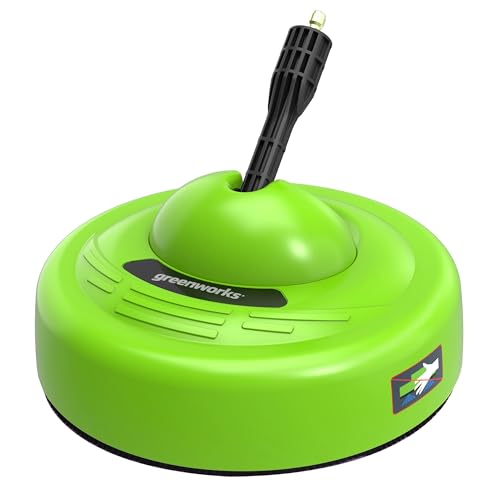
Pressure wash pavers with a surface cleaner, or with a 25-degree tip held eight to twelve inches away and swept at a shallow angle — never straight down into the joints — then re-sand the joints once the area is dry. Pavers are not a concrete slab. They are individual units held in position by sand, and that sand is both the thing that fails and the reason paver cleaning goes wrong.
Why pavers are a different job from concrete
A driveway slab is one continuous piece: you can hit it hard, and the only risk is etching the surface. Pavers are a jigsaw. The joint sand between them locks the whole field together and stops water getting under the bedding layer. Blow the sand out and three things follow: the pavers start to rock and shift, weeds seed into the empty joints within weeks, and water begins washing out the bedding sand beneath. That last one is what turns a flat patio into a wavy one a year later.
So the entire technique is built around one rule: clean the faces, not the joints.
Pressure, nozzle and angle
Nozzle: 25 degrees. A 15-degree tip is too concentrated and a 40 is too weak to lift embedded grime. If you are using a wand, the green 25-degree tip is the one. What the colors mean is in nozzle colors.
Never a zero-degree or turbo nozzle. A turbo nozzle will empty a joint in a single pass and it is quite capable of chipping the edge of a paver. It is the right tool for a bad concrete slab and the wrong one here — see turbo nozzle vs regular nozzle.
Distance: eight to twelve inches. Closer concentrates the force into a strip narrower than the paver face.
Angle: shallow, and across the joints. Spraying straight down drives water into the joint. Sweeping at a shallow angle across the joint lines lifts dirt off the faces and carries it away instead.
Pressure: a 1,600 to 2,000 PSI electric is plenty. This is a surface where more machine is not better. The job-by-job figures are in what PSI pressure washer do I need.
Why a surface cleaner is the right answer here
A surface cleaner holds its nozzles at a fixed height inside a skirt and spins them fast, so the force is split between jets and no point on the paver — or in the joint — gets more than a fraction of a second of exposure. You physically cannot hold it still in one place. That makes it both faster and substantially safer on pavers than a wand in an inexperienced hand.
Size it to your machine, not your patio. An 11-inch head is the only size that reliably spins on the 1.2 GPM electrics most people own, which is why the Greenworks 11-inch is the pick above. If your machine publishes 1.6 GPM or more, a 14-inch head will go faster. The flow-rate rules are in will a surface cleaner work on my pressure washer, and the technique is in how to use a surface cleaner.
Which cleaner, and the staining caveat
General grime and algae: Simple Green Oxy Solve Concrete and Driveway. The oxygenated chemistry is noticeably better on the green growth that makes a shaded patio look old, and the run-off is kinder to the beds it lands in. One caution worth knowing: the purple color can briefly stain very porous pavers, so test an out-of-the-way paver first.
Dull gray pavers that need brightening: Zep Concrete and Driveway Cleaner is a stronger chemistry at a low price per gallon. Keep it off plants and metal, wear eye protection properly, and keep it away from any adjacent wood or painted surface.
Motor oil: neither of the above. Oil has soaked in rather than sitting on top, and it needs a dedicated degreaser and time — see concrete cleaners.
Rust or efflorescence: the white bloom on new pavers is efflorescence working its way out, and it generally returns if you remove it early. Rust stains need a rust-specific product, not pressure.
The step everybody skips: re-sanding
You will lose some joint sand no matter how careful you are. Once the pavers are completely dry — not damp, dry — sweep jointing or polymeric sand across the field, work it into the joints with a broom, compact it by tamping or with a plate, and then activate or water it according to the product instructions. Polymeric sand sets slightly, which resists weeds and washout better than plain sand.
This is the difference between a patio that looks good this week and one that is still flat in three years. If you are going to skip something, skip the brightener, not the sand.
Sealing, and when not to
If you plan to seal, the pavers must be clean, dry and re-sanded first, and most sealers want a cure window with no rain. Sealing dirty pavers locks the dirt in permanently. If you are not sure, do not seal — it is a commitment, not an improvement.
If the growth keeps coming back
Cleaning removes the visible layer; it does not always kill the organism. On a shaded, damp patio the green will return within a season unless you used a cleaner with real biocidal action and gave it time to dwell. For a low-effort alternative that works slowly without any machine at all, see how to pressure wash a patio and best patio cleaners.