Greenworks has the simplest naming in the category and it works against them. Every machine is called after its PSI — 1600, 1700, 2000, 2100, 2300, 2700, 3000 — so the lineup reads like a straight ladder where more money buys more cleaning. It is not a ladder. Five of those models share the same 1.2 GPM water flow, which means they all take about the same length of time to clean the same driveway. One of them has nearly double that flow and will finish in half the time at lower pressure.
That is the whole decision on this brand, and the model name hides it. This page ranks the range on the number that is not in the name.
What I picked for, in order
1. Gallons per minute. Pressure decides whether dirt lifts. Flow decides how fast you move. At the pressures every machine here produces, dirt lifts fine; what you are buying with GPM is your Saturday afternoon back. A 1.2 GPM machine and a 2.3 GPM machine on the same two-car driveway are not close. If you read one other page before buying, read PSI vs GPM explained.
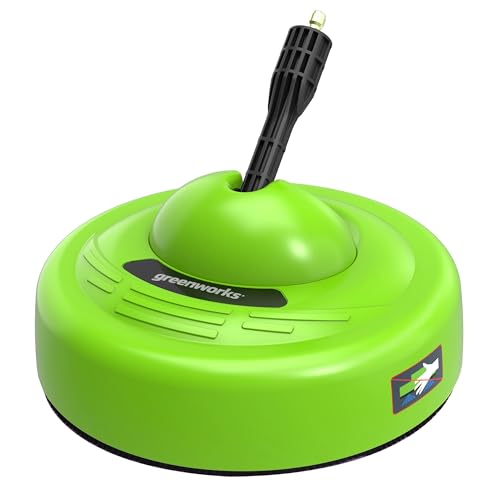
2. Whether a surface cleaner will actually spin. Surface cleaners are turned by the water passing through them. Below about 1.2 GPM an 11-inch head is the largest that spins properly, and a 15-inch head needs 2.1 GPM and up. Most of the Greenworks range sits right at the bottom of that, which decides which attachment you can ever buy.
3. Motor type. The Pro and brushless models use better motors that run cooler and quieter and have fewer wearing parts. On a machine you use six times a year this matters less than the marketing suggests. On a machine you use weekly it matters a lot.
4. Honest ratings. Greenworks publishes “2.0 GPM max” and “2.3 GPM” style figures, and one model in the range carries an SGS certification on its numbers. Certified figures get weighted above max figures, for the same reason a certified PSI figure beats a max PSI figure.
5. Weight and storage. Greenworks builds some of the lightest uprights in the category, and for a lot of buyers that is the deciding feature. A machine that lives in a closet gets used. A machine that needs two people to move gets resented.
The flow problem, with numbers
Here is the range as the catalog listings state it. The 1600 is 1,600 PSI at 1.2 GPM. The 1700 is 1,700 PSI at 1.2 GPM. The 2000 is 2,000 PSI at 1.2 GPM. The 2100 is 2,100 PSI at 1.2 GPM. The 3000 is 3,000 PSI at 2.0 GPM max. The Pro 2300 is 2,300 PSI at 2.3 GPM, and the 2700 is 2,700 PSI at 2.3 GPM max.
Read that twice. Four models sit at exactly the same flow, separated only by pressure, and the pressure differences between 1,600 and 2,100 PSI barely change what you can clean around a normal house. Then the Pro 2300 nearly doubles the water and costs about twice as much — and that is the only step in the lineup that changes the machine’s category rather than its spec sheet.
So the real choice is: do you need a driveway machine or a house-and-car machine? If it is cars, furniture, bikes, trash cans and the occasional stretch of siding, buy at the bottom of the range and spend nothing more. If it is concrete, go to the Pro and skip everything in between. The middle of this lineup is where buyers spend an extra hundred dollars for pressure they do not need and the same flow they already had.
Why the 2000 is the pick, not the 2300
The Pro 2300 is the better machine. The 2000 is the better buy for most people who come to this site, and those are different questions.
At 2,000 PSI and 1.2 GPM, the 2000 handles cars safely, cleans siding without stripping it, does patio furniture and bikes, and will get through a two-car driveway in an afternoon with a surface cleaner on the front. It is light, it is quiet, it stores upright in a closet, and it costs a fraction of the Pro. For a first pressure washer that is the right shape of compromise — the same logic as the beginners list.
Buy the Pro 2300 instead if any of these is true: you have a long driveway or a large patio, you already own a 15-inch surface cleaner, or you have washed a driveway with a 1.2 GPM machine before and remember how long it took. That is genuinely a different tool, and it is the Greenworks that competes with gas machines rather than with other electrics.
The 3000 is a trap for a homeowner
Three thousand PSI is the biggest number Greenworks sells on an electric and it is not the most capable machine in the range — the Pro 2300 cleans flat surfaces faster with 700 PSI less, because it carries more water.
What 3,000 PSI buys you is the ability to shift set-in oil and tire marks on concrete, which is a real job. What it also buys you is the ability to etch your own driveway, lift paint off a garage floor and carve a line in a deck board in the two seconds it takes to realize you are too close. Those are permanent. If you buy it, buy a wide tip and leave the narrow one in the box — pressure washer nozzle colors explains which is which, and surfaces you should never pressure wash is worth five minutes before the first use.
The cordless one, and what it is for
The 60V model is the interesting outlier: it runs from a 60V battery or from a wall outlet, which is a genuinely useful combination and rare in the category. At 1,800 PSI and 1.1 GPM on battery it is at the top of what cordless currently does, and it is still well below a corded machine on flow.
It earns its place if you already own 60V Greenworks batteries, or if the thing you want to wash is nowhere near a faucet — a boat on a trailer, a bike at a trailhead, or a camper in a storage lot. If everything you own is within fifty feet of a faucet, a cord is cheaper and better. The wider picture is in best cordless pressure washers.
Where Greenworks is weak
Thin accessory ecosystems. Greenworks sells fewer attachments than Sun Joe or Karcher, and the official ones are not always cheaper than universal alternatives. This is not really a problem — the quick-connect standard means most universal nozzles, guns and surface cleaners fit — but do not assume a brand-matched accessory is the right buy. Checking fit first is covered in the quick-connect guide.
Detergent handling. The lower models have token soap arrangements rather than real onboard tanks. Since soap does most of the actual cleaning on siding and patios, that is a genuine gap, and the workaround is a separate siphon setup or applying by hand first. See how soap injectors work.
Model churn and duplicate listings. The same machine often appears under two listings at different prices, and model numbers rotate between seasons. Check both listings before you buy and take the cheaper one that is actually in stock.
Light frames. The low weight that makes these easy to store also makes the smaller ones tippy when the hose is under tension. Not a dealbreaker; worth knowing if your yard slopes.
What I left out, and why
The 1700 and the 2700. Both are real, both are currently sold, and neither is the best answer to anything. The 1700 is the 1600 with 100 PSI more; the 2700 is the Pro 2300 with more pressure, the same flow and a higher price. If one of them is heavily discounted when you look, it is a fine buy — just do not pay a premium for the number.
The gas range. Greenworks is a battery-and-cord company. If you have decided on gas, the brands that build them properly are in best gas pressure washers and the honest trade-off is in electric vs gas.
How Greenworks compares to the alternatives
Against Sun Joe, Greenworks gives you a cleaner machine and a higher ceiling on flow; Sun Joe gives you more in the box and two soap tanks. Both sides are argued in Sun Joe vs Greenworks and the Sun Joe range itself is in best Sun Joe pressure washers. Against Ryobi it is close enough that availability decides it — Greenworks vs Ryobi. Against Karcher you are choosing lower price against better build, covered in Karcher vs Greenworks.
What to buy with it
Match the surface cleaner to the flow, not to the brand. On any of the 1.2 GPM models that means an 11-inch head — a 14 or 15-inch head will turn so slowly it leaves arcs. On the Pro 2300 you can run a 15-inch head at full speed, which is most of why that machine is worth the money. The sizing table is in surface cleaners for electric pressure washers.
After that: a longer hose, so the machine stays put while you move, and the right detergent for the surface. If the job that prompted this is a patio or a driveway, best pressure washers for patios and best concrete cleaners are the two pages to read next.